31 December 2013

Like Father, Like Son

Can't really believe I've finished three books in as many days!  On the one hand, I wish that I could do it more often, but on the other hand, I'd rather not have the cold that's kept me indoors and reading all the time.  But at least I've turned a negative into a positive!

The most recent book I've finished is 'Him and Me' by father and son team Michael and Jack Whitehall.  Whitehall senior is a retired agent who has worked with some very well known stage and screen actors, while Whitehall junior is a stand up comedian and actor, star of BBC Three's 'Bad Education' and Channel Four's 'Fresh Meat'.

'Him and Me' is a brilliantly conceived collection of funny stories spanning the Whitehall's shared life from Jack's birth until his late teens.  The anecdotes are amusing in themselves, but the book is made all the funnier by its structure.  Each tale written by Jack is supplemented with 'corrections' and footnotes by Michael and vice versa.  It's these comments that make it worth a read.

As you can probably tell, I rather enjoyed this book.  The footnotes make it much funnier than the average memoir and it's got a friendly, family feel because it's much like listening to two competitive relations telling stories, unable to resist who chipping in over the top of each other.  It brings the text to life and allows the authors to get away with all sorts of tall tales as it places everything firmly tongue in cheek.

Another great strength is also possibly the book's biggest weakness.  Because the book has two very different authors representing two separate generations, it has two potential audiences, one older and one younger.  The book could appeal to both groups - or maybe neither.  The language used and some of the humour (it seems nudity runs rampant in this family!) may put off an older reader, while the younger reader may get irritated by regular mentions of prestigious actors they may not be aware of.

In me, I think the Whitehalls have found the right audience however.  I love a bit of tongue-in-cheek, Carry On humour and enjoy older films and TV, so knew of a lot of the people mentioned.  Whether there are enough like me to make this a bestseller, though, I really don't know!

Overall, I'd recommend 'Him and Me'.  It's an easy, funny read and just the think to lighten up the dark winter nights.

Now, for a bit of Dark Ages intrigue with Bernard Cornwell and Lord Uhtred of Bebbanburg. 

29 December 2013

It's a Family Affair

I've just finished 'The House We Grew Up In' by Lisa Jewell, sent to me by publisher's Random House.  It's not a book I would've picked for myself, but it made a change reading something 'off list'.

'The House We Grew Up In' is the story of the Bird family; children Megan, Beth, Rory and Rhys, dad Colin and mum Lorelei.  At the epicentre of family life is the sinister eccentric Lorelei, determined that the fixtures of a perfect, rose-tinted childhood remain in place while stubbornly ignoring anything that threatens her idyll.  The pinnacle of the year is Easter Sunday in the Cotswold family home, a day of guests, egg hunts and roast lamb.  But one year the cracks give way and a shocking act rocks the family's image of itself.  As relationships are tested, is it too late for the Birds?

'The House We Grew Up In'
by Lisa Jewell
(Century, 2013)
The first thing that struck me about this book was how absorbing it was, a credit to the author Lisa Jewell.  She adeptly manages several different voices from several different times, drip feeding individual stories to keep the narrative pushing forward and the reader engaged.

Just as I felt I was on safe ground and that I had a grasp on the characters because I could relate to them, however, their behaviour started to take unexpected turns.  I suppose it makes sense in the context of the story, but everything did go a bit 'soap opera-y' and feel a bit out there.  But because of the understanding I'd gained of the characters in the first part of the book, I was willing to give the benefit of the doubt as I wanted to know what would happen to them.

Overall, I'm not sure that this is a book I'd recommend to many people as it's subject matter is actually quite dark.  It's not really a book to enjoy in the conventional sense.  I liked the writing enough to want to read more by the author, however, and intend to do so.  But I rather need read some more on the list first!

28 December 2013

Time for a Rhyme!

For obvious reasons, many friends and family members no longer buy me books for Christmas, but every so often someone can't resist.  That's how I became the proud owner of 'You Made Me Late Again!', Pam Ayre's latest collection of poems, anecdotes and sketches.

'You Made Me Late Again!'
by Pam Ayres
(Ebury Press, 2013)
Pam Ayres is well known for her wonderful ability to take the trials and trivia of everyday life and see the funny side.  As her fans know, she's also skilled at reflecting on everyday heartaches and reminding her readers that they're not silly for feeling sad.  All these sides of Ms Ayres' work are reflected in this latest volume.  As well as covering feeling terrible after a party that was a bit too much fun, loosing sleep over loosing sleep and an evening ruined because of worries about curling tongs that may or may not be on, her latest collection also makes observations on such varied topics as animal welfare, favourite pets (yours and other people's!), salespeople who let their expertise get the better of you, fly tipping, bigotry and Ilfracombe's sea front Damien Hurst.


I enjoyed this book, even though it's not something I would've bought myself.  I both cheered up and welled up as I read it Boxing Day and by the end found myself marvelling at all the little, shared experiences of life that are so easy to miss along the way.

As you may have noticed, I'm not a big fan of poetry, but just as Ms Ayres' subjects are accessible, so are her rhymes, so don't let the label put you off.  It was also good fun to have prose and sketches mixed in with the poems.

Overall, this was lovely surprise and a charming read that I would recommend, although it's probably more for the girls than it is for the boys.  I certainly enjoyed it and am sure I'll read it again.  A well chosen Christmas present gratefully received!

17 December 2013

Mega Bite

I really don't get the modern thing about vampires being sexy.  I understand where it all came from - the whole hypnotic, animal magnetism thing - but it's really gone too far.  They're predators that rip people's throats out, for crying out loud, not harmless, puppy-eyed boys who just need someone to change them!  If I were conspiratorially inclined, I'd start wondering if we were being prepared for some sort of undead invasion.  Or was that just an episode of 'Being Human' I once saw..?

The big noise in vampire circles has to be Dracula and I have finally finished the Bram Stoker novel of the same name.

'Dracula' begins with solicitor Jonathan Harker travelling to a castle in remote Transylvania.  Seeing the local superstitions as quaint and backward, he fails to realise how much danger he is in until it's too late. Harker has been employed to complete a house purchase for Count Dracula and, once done, he finds himself trapped in the castle as his host's eccentricities are revealed as something more sinister.  Meanwhile, back in England, friends Lucy Westernra and Mina Murray are planning their futures.  While Mina waits for her fiancĂ© Harker to return and Lucy picks Arthur Holmwood from a trio of suitors, the girls dream of a future of wedded bliss.  But dreams soon turn to nightmares as Lucy's sleepwalking puts her in harm's way and the friends find themselves the victim of some unknown horror...

In a way, I feel a bit sorry for 'Dracula'.  The book was seized by film makers almost as soon as it was published and, like Sherlock Holmes or James Bond, the character has outgrown and evolved far beyond the original source material.  Everyone thinks they know Dracula, so it's really hard to leave all that baggage at the front cover and come to the book with an open mind.

The other reason why this book took me six weeks to read is the language.  'Dracula' is at times tense, exciting, unnerving and action-packed, but unfortunately I find 19th century prose really heavy going.  The long sections of dialogue were frustrating and hard work and Stoker's depiction of Professor Van Helsing's accent swings between embarrassing and racist to modern eyes.  As a result, I didn't exactly steam through it.

I'm very glad I persevered, however, and did finish the book because I discovered that it wasn't about what I thought it was about.  It's often said that great stories or characters live on because they're reinterpreted for different times.  So, for example, vampirism has been used as a metaphor for lust, for addiction and for contageous disease.  It turns out that 'Dracula' is actually about old vs new, ancient vs modern and tradition vs technology.

It's also about other things too, like solitude and friendship, teamwork and faith.  But what it's not about is sexy, seductive, aristocratic men and the promise of eternal youth.  But hopefully, that's just the latest interpretation and in a few years we'll see something new come around which doesn't seem quite as distasteful in a modern world of airbrushing, body dysmorphia and eating disorders.

Overall, 'Dracula' was quite an interesting and, I suppose, thought-provoking, read, but I wouldn't recommend it unless you're lucky enough to find old fashioned writing styles a doddle.  Equally, however, I'm not aware of any film or TV adaptation I'd recommend either.  In truth, although I doubt I'll ever read this book again, I may listen to it on CD, which I suppose continues the novel's main theme!  Hopefully the BBC have done a really good adaptation, but in the meantime, it's back to the shelves!

A view across Whitby

08 December 2013

Who's Confused, Clarice Bean?

In the words of Noddy Holder, it's Chriiiiiiiistmaaaaaaas!  Well, nearly.  It's definitely prezzie buying season and for me that means some guilt-free trips to the local book shops!

I'm very fortunate in that I've got to an age where I have lots of children to buy for.  It gives me a chance to catch up on what's happening in that brightly coloured section which I never used to go in to.  An awful lot seems to have changed since I was a kid.  I'm pretty sure there are a lot more books now and a lot more authors too.  Enid Blyton, Roald Dahl and the Ahlbergs are still there, often with whole shelves to themselves, but even these big names are sometimes quite hard to spot among the spines embossed with those I've never heard of.  Equally, I've been surprised to see some familiar names from other spheres in the children's section - David Walliams always seems to busy, so I was amazed to find he'd published four children's books!

All this change leads to a weird sense of wonder and disorientation when I'm in a children's section.  Sometimes this actually begins way before I even get to the shop.  For example, one conversation I had with a mum in the run up to last Christmas went something like:

"What would your daughter like for Christmas? What's she reading?"
"She likes Clarice Bean books."

"Pardon?"

"Clarice Bean."

"What on Earth is a 'Clarice Bean'?"

All I can say is I'm grateful for Google.  As it happens, I had a brilliant time researching Clarice Bean books.  'My Uncle is a Hunkle' is probably one of my favourite book titles of all time.

Although it's great that this area is churning with new authors, for an oldie like me it's reassuring to see that the books I loved as a child are still available.  I've mentioned Dahl and Blyton already, but it's great to see Mr Majeika, Flat Stanley and Mrs Pepperpot are all still around.  It's easy to look back on the things we loved as children with rose-tinted spectacles, so it's good to know that these books have stood the test of time and are still enjoyed by new generations.

And that, I think, is an important point.  Parents share the stories they loved with their children, perhaps even the actual books they read themselves when small.  Some of my fondest memories are of my father reading to me and I've enjoyed reading to other people's children - hopefully they liked it too!  Sharing stories is something that human beings have done since the dawn of time, an act which helps groups and families bond and allows important lessons to be passed on.

So, perhaps while I enjoy buying books for children because I just love books, maybe its actually part of something a bit bigger and more important.  Or maybe I'm just looking for a really, really good excuse to go book shopping!

Now, enough of the nostalgia, back to the reading!

30 November 2013

Previously from the Girl Who Loves Books III

Oh dear.  It's all gone a bit wrong this month.  No idea why, although it's probably something to do with it being too cold to sit outside and read now winter has finally arrived in the UK. Turning pages is just too tricky with freezing fingers!

So, by way of an apology and to say I've not forgotten you, here are some reviews I wrote before starting this blog. Hope you enjoy them!

'Cautionary Tales for Grown-Ups' by Chris Addison

`Cautionary Tales...' is a collection of humorous rhymes, each of which deals with a different 21st century `sin' and wreaks terrible (and often grotesque) vengeance on the perpetrator. The crimes against society include browsing in bookshops rather than buying, NIMBY-ism, reality TV shows, littering, driving 4x4s in town, excessive Christmas lights and nude charity calendars among many others.

After reading this book, I have very mixed feelings. I liked the idea of it very much, but was disappointed that the stories were in rhyme rather than prose. It has the unfortunate effect of making the tales seem insubstantial, as if the author had been knocking up a poem or two every time he got bored and had a spare five minutes. I found them amusing rather than funny and it did make me wonder whether they would have been funnier if developed into full short stories. Also, this is a very middle class book and some of the morals did come across as a bit patronising. On the plus side, there were some poems which did make me laugh out loud, although there were also some punishments which made me wince!

Overall, this book feels like it may be the start of something interesting which could be developed, but it also feels like a throw away doodle and isn't really worth the £7.99 price tag. It could, however, be just the right gift to bring a smile to the wound-up whinger in your life.

'The Vampire Lestat' by Anne Rice

When I wrote my review of `Interview with the Vampire', the first of Anne Rice's Vampire Chronicles, earlier this year, I ended hoping that its sequel would be less ambiguous. I am delighted to say it is, although it almost goes to the other, indepth extreme!

`The Vampire Lestat' is a hefty tome which principally follows the life, creation and afterlife of the enigmatic Lestat de Lioncourt, a minor French nobleman who dreams of more than the futile existence dictated by his position as the younger son in a poor but arrogant family. But this book is also about so much more. This second Chronicle is a lot thicker than the first for the simple reason that it not only contains the `life' story and personal development of Lestat himself, but also the histories of two older vampires, the elegant Marius and the lost Armand, as well as legends of the race's origins and the first vampires, Enkil and Akasha. Like the first book, `The Vampire Lestat' continues to ponder life and death, good and evil and where vampires fall in the grand scheme of things, but there is also a lot of action and adventure which give the overall tale much more bite than the first and greatly improve its pace.

Although I enjoyed this much more than `Interview...', I believe that both books should be read rather than one or the other. `The Vampire Lestat' casts a great deal of light on the events of `Interview...', placing it in the context of Lestat's existence and explaining much of the what happened between Lestat, Louis, Claudia and Armand. It's almost as if `Interview...' is a taster for `The Vampire Lestat' rather than a novel in its own right.

In short, although its length made it hard to keep momentum towards the end and I feel a bit cheated because it's now clear that the second and third Vampire Chronicles are really one book/story rather than two, I feel that my perseverance has been rewarded and I am keen to continue reading. `The Vampire Lestat' is exciting and interesting, just as its predecessor verged on the depressing and perverse, and it really is a great read. Just try not to be put off by the size of it!

'Demelza' by Winston Graham

This is the second of the twelve Poldark novels. As such, I began it a little worried that, like far too many sequels, it wouldn't live up to expectations.

`Demelza' begins a few months after `Ross Poldark' and with the birth of Ross and Demelza's first child, Julia. It covers a turbulent time for the couple, as poverty and illness ravage Cornwall and relations with cousin Francis are once again become strained. As Demelza spreads her wings and begins to find a place in society, Ross becomes involved in a venture that threatens the Warleggan's financial stranglehold on the county, putting the young family in danger from their shadowy influences. Meanwhile, there are developments between cousin Verity and the disgraced Captain Blamey and a love triangle develops between the new doctor Dwight Enys, miner Daniel Martin and his new wife Keren.

I'm delighted to say that this book was as far from a disappointment as you can get. Once again, Mr Graham evoked a powerful sense of time and place which was completely absorbing. The plot is a rollercoaster of joys and misfortunes which culminates with a dramatic description of two ships being storm-wrecked and looted, a pivotal event which is intrinsic to the next book.

I would thoroughly recommend this book to any fan of Cornwall-set or historical fiction. Unlike much historical fiction, the world that this author creates feels all the more realistic because it doesn't shy away from tragedy nor exclude the humour of everyday life. As such, both `Ross Poldark' and `Demelza' stand out for me and, once again, I hope that the remaining ten books in the series do not disappoint!

'Angels: A History' by David Albert Jones

`Angels: A History' is an excellent, if rather brief, introduction to the subject of these celestial beings and their origins in Jewish, Christian and Islamic scripture. Although the text is quite dry at times and can read like an edited essay, it manages to cover a lot of ground in a very simple, factual way which meant that I learned quite a lot from a relatively short book. This book would not be out of place in the excellent Oxford `Short Introductions to...' range, which, if you are familiar with this series, gives an indication of its style.

My only criticism of this book is that its title is a bit of a misnomer. It is not really a history of the angels, more a summary of the original sources on the subject and what they tell us about these beings. In a way, it feels like the first few chapters of a longer book. Although more modern representations of angels, including on film and in art, are mentioned, it is always to support a point made rather than as part of a linear, chronological narrative.

Even so, this is still a fascinating insight into where our modern idea of angels came from and gives some indication as to why they have remained such an emotive concept within modern cultures. Recommended for those curious about the subject but who do not know where to start.

Related Posts

Previously from the Girl Who Loves Books I

Previously from the Girl Who Loves Books II

30 October 2013

What's that Coming over the Hill...

I really have to stop reading about warlords and battles before bed.  After finishing 'Death of Kings' by Bernard Cornwell, I'm far too buzzy to sleep!

'Death of Kings' by Bernard Cornwell
(Harper Collins 2011)
'Death of Kings' is the sixth book in Cornwell's Saxon Stories series, which tell the story of the birth of England through the eyes of pagan warrior Uhtred of Bebbanburg.  Lord Uhtred's career as King Alfred the Great's most feared warlord has earned him reputation, but not wealth.  While he scratches a living from the poorest of Mercian estates, King Alfred himself is slowly dying.  But despite the continued threat of Danes from the north, the king is determined that his dream of a united country shouldn't die with him.  Eager to cement alliances before it's too late, he agrees to send Uhtred with a peace delegation to King Eohric of East Anglia to negotiate an alliance.  But all is not as it seems.  Politics and power struggles soon come into play and before long Uhtred finds himself once again in the thick of battle.

This book has a broader canvas than the previous novel, 'The Burning Land'.  'Death of Kings' takes in a wider political view, involving hungry rulers from across the borders of the Daneland, Mercia, East Anglia and Wessex.  The last book focussed very much on Uhtred and his love/hate relationship with Alfred, but here we see the bigger picture and how, as our favourite warlord finally gets his just rewards, the machinations of others could see him and the West Saxons lose everything.

Despite the greater breadth of the plot, Cornwell, like the seasoned professional he is, manages to keep the reader up to speed with all the characters and backstories without overdoing it and becoming tedious.  As such, the book remains highly readable and doesn't get irritating bogged down or confusing.

An air of impending doom hangs over this story and the way it was managed made me keep reading.  From the title alone we know King Alfred isn't long for this world and with so many greedy eyes on Wessex, it's easy to see that there are those who see opportunity in his death.  This is a great source of suspense that is worked brilliantly from beginning to end.

Overall, Mr Cornwell has done it again.  'Death of Kings' is an atmospheric and suspenseful novel and yet another fantastic read.  Special mention has to go to the final battle scene.  In a series of books where battles are ten-a-penny, they could easily become uniform and predictable.  The last battle featured in this book really stood out for me, however.  This was possibly because it was so near the end and I was conscious that I was running out of pages, but in reality there is far more to it.  But I daren't say more because I don't want to spoil it for anyone else!

Now, I'm off to try and get some sleep!

Related Posts

'Sword Song' by Bernard Cornwell (Saxon Story Four)

'The Burning Land' by Bernard Cornwell (Saxon Story Five)

11 October 2013

Burn, Baby, Burn

Earlier this week, I finished 'The Burning Land' by Bernard Cornwell, the fifth book in the (currently) seven strong army of novels set during the reign of Alfred the Great.

'The Burning Land' by
Bernard Cornwell
(2009, HarperCollins)
It's the late 800s and the greedy eyes of the Vikings are still fixed on Alfred's flourishing kingdom of Wessex. Looking for gold, power and reputation, two notorious Norsemen, Jarl Haestan and Harald Bloodhair, land in the country.  While Haestan is content to wait for Alfred to buy him off, Harald ravages the land, leaving a trail of devastation in his wake.  Before long, Uhtred of Bebbanburg, the king's reluctant oathsworn warrior, finds himself once again doing the calculating king's dirty work, going into battle to defend a country not his own.  But this is an Uhtred whose success has made him confident to the point of arrogance, whose fury is fuelled by his enemies at court and who is made discontent by his burning ambition to retake the Northumbrian castle stolen from him by his uncle.  Will Uhtred's bitterness overwhelm his judgement? Will Wessex's greatest warlord be there in its hour of need? Or, after so many year's of service, will Uhtred finally burn out?

I bloody love Bernard Cornwell's books.  I wish I could say something more intelligent or analytical, but that really does sum it up.  They're not high literature and shouldn't be read as such, but they're absolutely fantastic, rollicking, gung ho stories that sweep you up and keep you galloping along to the last page and beyond.  The atmosphere Mr Cornwell creates is amazing and it's hard to visit any location mentioned without trying to imagine it all those centuries ago.  A bit of escapism does us good once in a while.

This isn't everyone's idea of historical fiction - this is blood-and-guts rather than cloak-and-dagger or romance-and-royalty - but boy is it good fun!

'The Burning Land' is part of a series and, as such, does feel a bit of a stepping stone, but that's not really a problem.  Because you know there are more books to follow, it just makes you wonder what waits in store for Uhtred and how long it will be until he makes a final play for his hereditary home.  Although it is carefully structured (lead up to battle, battle, trouble, adventure, lead up to battle, battle), this book is not filler, it propels Uhtred's story forward and takes him into a different direction with a whole new set of possibilities. I can't wait to see what this means for him in 'Death of Kings' and just published 'The Pagan Lord'.  After all, there's no smoke without fire.

Admittedly, Uhtred is not the nicest of characters - he's petulant, grumpy, thuggish and, at times, driven by his less than noble passions.  You may not want to be mates with him, but he's a hero, has a spark of intelligence and a sense of justice and it's hard not to cheer him on as he joins another shieldwall or fights another battle.

Overall, if you want to escape from the daily grind of more cuts, bland characters and the first gloomy signs of autumn, here's a ring of fire you might enjoy diving into.

Now, the newly published Jung Chang or some more Saxon sword clashes?

Relevant Posts

'Sword Song' by Bernard Cornwell (Saxon Stories Book Four)

24 September 2013

The Ballad of Zeb and Toby

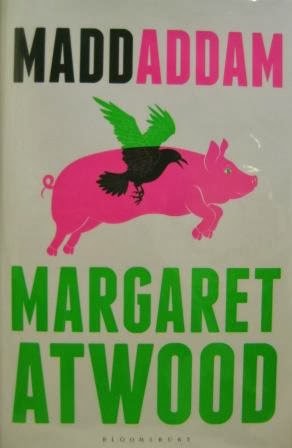
I've just finished the recently published 'MaddAddam' by Margaret Atwood, the last in the superlative 'Oryx and Crake' trilogy. Must've been good for me to finish it in just a week!

'MaddAddam' by Margaret
Atwood  (Bloomsbury, 2013)
'MaddAddam' begins as 'The Year of the Flood' ends. The human race has been largely wiped out by a mysterious virus, but a handful of outsiders have survived. Many are former God's Gardeners, a Christian Environmental sect that values nature and cultivates self-reliance, or members of MaddAddam, a terrorist group that dispensed with the Gardener's pacifism and used genetic know-how to cause disruption to the ruling corporations.  But they are not the only people left alive. Two psychotic competitors from the Painball games have escaped the plague and want nothing more than to torture, rape and kill.  Having saved Amanda from them once, with the help of Ren and the unexpected arrival of Snowman-the-Jimmy, Toby lets down her guard and the Painballers escape.  Will Toby and the other survivors find them before it's too late? How can they protect the innocent Children of Crake? And what of the mysterious Zeb?

Atwood has pulled off a fantastic hat trick with these three books and 'MaddAddam' is the captivating conclusion to a thrilling trilogy. While books one and two told the stories of Glenn, Jimmy, Ren and Toby, here we find out about the enigmatic Zeb and spend more time with the Children of Crake, the genetically modified replacement for human beings.  Once again, Atwood juggles the varied voices involved fantastically and it's easy to forget that they all come from the mind of one author.

'MaddAddam' is probably the most surreal and fanciful of the three books, but it is set after the apocalypse and feels right for the world that Atwood has created.  Or should I say predicted?

The ending did leave me feeling bereft, but, as any reader will tell you, that's not unusual when you've enjoyed a book and grown attached to the characters involved.

Overall, I would really recommend the Oryx and Crake trilogy to anyone who enjoys thought provoking books which challenge the way we see the world. This is Speculative, rather than Science, Fiction at its best.

Now, back to Bernard Cornwell's Saxons vs Danes Round Five: Pride Comes Before a Fall. I'm only on page 48 and I think I can see where this is going! Really don't mind though. Honest.

17 September 2013

Apocalypse Wow

Technically, I've lived through several expected apocalypses.  I survived both the fever caused by the Millennium Bug in 1999/2000 and the end of the Mayan calendar in December 2012. Oh, and that time that asteroid skimmed past the Earth a couple of years ago. I'm sure there have been many more 'false alarms', but I somehow find our obsession with the end of the world intriguing, particularly as in all likelihood we either won't see it coming or will ignore it's coming because we don't want to change our destructive ways.

Anyway, I've just finished reading 'The Year of the Flood' by Margaret Atwood, the second book in the 'Oryx and Crake' trilogy.  'Oryx and Crake' has the rare distinction of being one of only a handful of books which I've read within two days.  Aren't train journeys great?

'The Year of the Flood'
by Margaret Atwood
(2010, Virago)
'The Year of the Flood' runs parallel to 'Oryx and Crake'.  Both books cover the lead up to and immediate aftermath of a terrible pandemic that wipes out the majority of mankind, but told from two very different perspectives.  While 'Oryx and Crake' witnesses the end of days from the upper class, high security compounds of society's elite, 'The Year of the Flood' explores the poorer and criminal strata of the population in the hard and vicious pleeblands.  The pleebs are home to Toby and Ren, two women who have survived the plague and now tell their own, intertwined versions of events.  Toby is living alone on the roof of the AnooYoo spa, nurturing her rooftop garden and nervously watching the horizon for disease carrying humans, predatory wolvogs and inquisitive pigoons. Meanwhile, Ren is trapped in quarantine in Scales and Tails, a high class strip club, wondering just how long her food will last and if anyone will find her before it's too late.  Are they the last human beings alive? Will they find each other?

As you might've guessed from my recent tweets (@Girl_LovesBooks), I thoroughly enjoyed this book (if that's the right word for it!  The story is incredibly dark and violent in places. But the end of the world was never going to be cheerful.).  I loved 'Oryx and Crake' and Atwood's other famous apocalyptic novel, 'The Handmaid's Tale'.  Atwood is an absolute master when it comes to looking at modern trends and extrapolating plausible futures from them, making her stories different and captivating yet familiar and real.  On top of this, 'The Year of the Flood' is pacy and Ren and Toby flawed, fragile and human characters that you root for.  It's an irresistible combination that makes 'The Year of the Flood' a real page turner, even when you know what's coming.

I also absolutely love the way Atwood plays with language. As well as the AnooYoo spa, there are the genetically engineered animals including rakunks and Mo'Hairs, new technology like the Sea/H/Ear Candy ear phones and foodstuffs including Zizzy Fruits, ChickieNobs and Happicuppa.  This adds a playfulness to the story which makes it easier to handle its darker elements.

Overall, I enjoyed this book so much that I've moved straight onto the third in the trilogy, the recently published 'MaddAddam'.  It'll be an interesting test, especially after the bad experience I had recently trying to read the whole Cousins' War series by Philippa Gregory in a row. So we'll have to see.

The world has ended. So what now?

31 August 2013

The Scarlet Woman

I've done it! Only just, but I've done it! That's another two books read this month!

Last night I finished 'The Red Queen' by Philippa Gregory, the third book in her Cousins' War series and part-inspiration for the recent BBC serial 'The White Queen'.

'The Red Queen' is Margaret Beaufort, daughter of the House of Lancaster and cousin of the unfortunate King Henry VI.  Married to Henry's 24-year-old half-brother Edmund Tudor at just 12, she learns early that while an important tool in dynastic power games, she's not free to make her own decisions or wield power herself.  Tudor dies two years later, but not before the 13-year-old Margaret becomes pregnant. She endures a horrifying birth which, fortunately, results in a baby boy.  Naming him Henry after the troubled king of England, she sees her son as rightful heir to the throne and begins to set her sights on the ultimate prize. But will Henry Tudor support his mother's ambitions? Will her plans be discovered by the new York kings? Will either of them survive long enough to claim the crown for themselves?

'The Red Queen' by
Philippa Gregory
(Simon & Schuster, 2010)
I must admit I wish I hadn't started this.  Not 'The Red Queen', it's not that bad. I mean that I wish I hadn't thought it would be a good idea to read a whole series of books in a row.  The trouble is that this isn't a 'series' in a chronological sense.  Instead of one book leading to the other, perhaps with a little transitional overlap in between, both 'The White Queen' and the 'The Red Queen' cover the same time period but from two different perspectives. And it's hard not to get a bit bored when you've heard some bits of the story before, especially when so much of both books consists of the lead characters waiting for news and wondering what's happening.

It also doesn't help that the narrators are women.  I applaud Ms Gregory's intention of bringing female historical figures out of the shadows, but this doesn't change the fact that very few of them were allowed to actually do very much.  I was vaguely aware that Lady Margaret Beaufort was her son's greatest confidante and advisor (none of which comes across here, so I'll have to check now.), but prior to gaining the status of King's Mother, things appear to have been very different.  Beyond giving birth to Henry and finding a politically astute husband willing to support her, she doesn't really do that much in this book. What she does do is interesting, but not really enough for a whole book.  The fact that Ms Gregory has to tell the final section of the story in third person away from Lady Margaret kind of suggests that even she was struggling at that stage.  She didn't even bother to have her recount the story as if she'd heard it afterwards or a messenger tell her what happened.

Really, I feel that I would've enjoyed this book and its predecessor a lot more if they'd been written like 'The Other Queen', with multiple narrators, each contributing their perspective on the story to create a whole picture.  I also think I might've liked it more if I'd not read it straight after 'The White Queen' as I may have forgotten some events and needed the reminder, but then again I didn't know that there was going to be so much overlap.  Afterall, I loved 'The Lady of the Rivers', the first book in the series, and there was hardly any duplication between that and 'The White Queen'.

The one thing I would recommend this book for, and which shows Gregory at her best, is the birth of Henry Tudor. The incident is so shocking and awful that it could put you off having children for life. Then you remember that this was the suffering of a 13 year old girl and it all feels a lot worse.  Ms Gregory is known for her skill in creating a sense of time and place through her characters and this is the only point at which I really felt it in this whole book.

I don't really want to be negative about the work of such a fantastic writer, but I didn't enjoy this book as much as I have books from the Tudor series and doubt that I'll bother reading the new novel, 'The White Princess'. What I will probably do, however, is look up some non-fiction books about the key characters portrayed.  When I've got a few more titles off the shelves of course!

Now for something a bit different.  Science fiction anyone?

10 August 2013

Oh, Mr Darcy!

As you may have noticed, I'm a bit of a collector of book related silliness.  I tweeted recently about a massive statue of a soggy Mr Darcy erected to promote a new TV channel.  I'm guessing the 1995 BBC version of 'Pride and Prejudice' in which Colin Firth takes his now legendary dip will be a feature in its schedules.  Anyway, you have no idea how pleased I was when I had a day trip to the National Trust's Lyme Park recently and saw it for myself!  Not what I expected, for sure!


Lyme Park is well worth a wonder round if you like that kind of thing, with some lovely but manageable grounds and very friendly guides in the rooms.  Don't forget to return your leaflets, though, they're quite strict about that sort of thing!

03 August 2013

The Writing is on the Wall

Earlier this week, I paid a visit to Sheffield Central Library in the North of England.  The site is also an art gallery and the Council has added some lovely quotes about libraries to the walls to inspire people using the building.  As some of you may not get the chance to go there, I wanted to share them with you, so please enjoy!

"I have always imagined that Paradise will be a kind of library"
Jorge Luis Borges

"Libraries gave us power"
Manic Street Preachers

"A library is an arsenal of liberty"
Anon.

"There is no institution I value more in this country than libraries"
Michael Palin

"Logic will get you from A to B, imagination will take you everywhere"
Albert Einstein

"Without libraries what have we? We have no past and no future"
Ray Bradbury

"A free library system is one of the trademarks of a civilised society"
Terry Jones

If you have any great book or library related quotes, I'd love to hear them! Tweet them to me @Girl_LovesBooks.

01 August 2013

The Truth is Out There

After 'The White Queen', I needed a bit of a break from the Plantagenets, so did a bit of a lucky dip and picked up 'Will Storr vs The Supernatural' by Will Storr (funny that!).

In 'Will Storr vs The Supernatural', the journalist tackles some big questions; Do ghosts exist?  Can people be possessed?  Is there life after death?  In 21 snappy chapters, Storr interviews demonologists, paranormal investigators, exorcists, psychologists and psychics looking for answers in some of the shadowiest corners of eccentricity.  Will he find some truth or just get lost in the dark?

Like a scary story, this book just made you keep reading.  Each chapter is punchy and takes you somewhere that most people will never go.  After all, even the most hardened sceptic probably doesn't fancy spending the night in the cold, dark and damp of a supposedly haunted house.

'Will Storr vs The Supernatural'
by Will Storr
(Ebury Press, 2006)
Throughout, our guide manages to tread a careful path between open minded and sceptical, letting his curiosity take control.  The subjects' stories are told with compassion and humanity, never losing sight of the likely driving forces behind their often frowned upon beliefs: loss, insecurity and the fear of death.

Despite its subject, this book is anything but heavy and serious.  It's not a scientific or psychological treatise on the supernatural, so don't expect a convincing argument one way or another.  It's one person's conclusions drawn from his own experiences and encounters.  It's also written for entertainment and while it's not necessarily laugh-out-loud funny, it is amusing without mocking the interviewees or their beliefs.

Overall, I found this book fascinating and loved Storr's style of writing and turn of phrase.  Far from frightening me off, I will be looking up other books by the author and hoping for more of the same.

Now, a bit of time travel.  Back to the Red Queen!

30 July 2013

The Bland Queen

I have finally finished 'The White Queen' by Philippa Gregory, the second in the 'Cousins at War' series of books (chronologically anyway!).

'The White Queen' picks up where 'The Lady of the Rivers' finished, with Jaquetta's (Lady Rivers') daughter Elizabeth Woodville heading out to meet King Edward IV at the roadside.  Elizabeth is a noted beauty and Edward a notorious womaniser, so it's not surprising that romance (or lust depending on how you look at it) follows.  The couple marry in secret, an act which has terrible repercussions, bringing war back to the country once more.  Whether married for love or political ambition, Elizabeth, now the White Queen of York, finds herself on a journey that sees her become by turns first lady of the land and outlaw in sanctuary fearing for her life and the lives of her children.  So where will the White Queen's Wheel of Fortune stop turning?

'The White Queen' by Philippa
Gregory (Simon & Schuster
UK Ltd, 2009)
I'm sorry to say that I didn't really begin to get into this book until about two thirds of the way through.  The first part is basically historical fiction romance porn, full of lust and illicit love affairs, the second part sees Elizabeth a long way from the action (at this point I wanted to follow her husband's narrative, not hers) and finally, in the third part, the White Queen starts to get fleshed out a bit and become a real, interesting character.

The final chapters see her hiding in sanctuary with her children, at which point conflict begins to develop between her and her eldest daughter, all based around Elizabeth's 'ambition'.  To be honest, I hadn't noticed that she was ambitious until this point, just that she was a pawn of her mother (who has changed a lot since 'The Lady of the Rivers'). But once she'd been told she is ambitious, Elizabeth seemed keen to make up for lost time.  As well as being ambitious, Elizabeth is also shown to be hopelessly politically naive, which makes it much easier to see her as a human being and even begin to relate to her.  Before that, I couldn't get any sort of grip on her motivations and it made it hard to like/dislike/care about her.

There also seems to be a lot of padding in this book, a lot of phrases and ideas repeated within pages just in different words.  I got absolutely sick of hearing about Elizabeth's hat coming off and her hair being unpinned and falling down.  Also, the habit of modern language slipping through which I first noticed in 'The Other Queen' has reared its ugly head again.  Note to editors: If a sentence ends with 'here' and when you delete it the meaning stays the same, then delete it.

Sadly, this book feels like a first draft.  There is a really great story in here and it's an OK read if you've got the time to spend on it, but I know Ms Gregory can do better and it's really disappointing to read something that just doesn't hit the usual mark.  Then again, it's often things going wrong that make you appreciate it when they go right.  So bring on the Red Queen!

08 July 2013

Rivers Run Through It

See what happens when I get a bit determined?  A 497 page book read in nine days flat.  Result!

I've just finished reading 'The Lady of the Rivers', chronologically the first in Philippa Gregory's 'Cousins at War' series.  I was getting a bit washed out by the flood of promotion around the BBC series based on the books, so thought I'd better get started on the novels so I could watch it!

'The Lady of the Rivers'
by Philppa Gregory
(Simon & Schuster UK, 2012) 
The lady of the title is Jacquetta, a daughter of the House of Luxembourg, a family which traces its source to a union between a man and the water sprite Melusina.  These unusual origins are said to give the Luxembourg women the gift of foresight, bringing Jacquetta to the attention of the Duke of Bedford, King Henry VI of England's commander in France.  Bedford marries Jacquetta to use her in his alchemical experiments and no more, leaving her feeling unhappy and confused.  The waters are muddied further when she begins to have feelings for one of the Duke's retinue, Richard Woodville.  When the tide of war turns and the Duke and his household return to England, they find a king whose direction changes with his advisor and an increasingly disgruntled ruling class.  Will Bedford convince the King to fund the fight in France? Can Jacquetta find love and retain her honour? Could disagreement between royal cousins really lead to war?

You have no idea how hard it was for me not to say more in that paragraph.  This is really only the very start of a book which took me on an unexpected journey through the early years of the Wars of the Roses, as we call them today.  All I really know about them is that Henry VII brought them to an end through battle and marriage.  As such, even though this is clearly historical fiction, 'The Lady of the Rivers' gave me a taste of the era and an overview of the key events that has made me want to read more.  This is just as well as there are another three books in the series already and at least one more on the way.

Which leads me onto a bit of a niggle I have.  As readers can see from the family tree at the front of the paperback edition, Jacquetta is rather 'productive', giving birth to 14 children by the end of the novel.  Somehow she carries these babies successfully while riding horses, getting caught up with the boisterous London mob and stressing about her husband, children and Queen.  Clearly, she was made of stern stuff!

As I say, though, this really was just a drop in the ocean, much like the alchemy near the start of the book.  There was a point at which I thought "Where on Earth is this going?" because I was a bit worried that the themes of magic and alchemy were going to drain the book's feel of realism.  Talk to any Philippa Gregory fan and they'll tell you that they love the way she evokes the past and makes it feel realistic, so it worried me a bit that the novel might be slipping into 'Lord of the Rings' territory!

I needn't have worried on either count, though, as 'The Lady of the Rivers' is an absorbing book introducing fascinating historical figures and a time period I really would like to know more about.  Not only am I hoping that the other books in the series will help to start bridging the gap in my knowledge, I hope that the people they introduce will be equally intriguing and I'll get so swept up in the flow of the story that I'll read them just as quickly!

Now, to 'The White Queen'!

02 July 2013

Getting the Sums Wrong

I've just realised I've been lying to you all this time!  Although my profile says I've been trying to read all the books I own since August 2010, my running totals only started with the blog, in May 2011!

I have now added everything I read between those dates, bringing me up to a more impressive 66 books over the past 34 months instead of 49.  That's a monthly average of just just under two, not quite what I'm aiming for, but far off at all.

Now that's cleared up, had better get back to the Lady of the Rivers.  I've got a target you know!

29 June 2013

We are Family

Oh dear.  June really hasn't gone as well as it should've in reading terms, has it?  Nevermind, will have to do much, much better in July..!

I've just finished 'The Unknown Ajax', my first Georgette Heyer.  I was really apprehensive when I started reading.  I may have mentioned (!) that I don't really get on with Jane Austen books and because Heyer is famous for her Regency romances, I was worried that they may be similar.  I needn't have worried - I thoroughly enjoyed this book.

'The Unknown Ajax'
by Georgette Heyer
(Arrow Books, 2005)
The Ajax of the title is Major Hugo Darracott, who, despite being a stranger to his family, finds himself heir to its ancestral lands, house and title.  The child of Lord Darracott's second son following an unapproved union with a Yorkshire weaver, the Major is only summoned to the family seat when his Lordship finds he can't disinherit the mysterious young man.  Lord Darracott has ruled Darracott Place and his children and grandchildren with a rod of iron for longer than anyone can remember, so what will happen when the straight-talking "weaver's brat" finally makes his appearance?

The thing that surprised me most about this book was how funny it was.  There is a dinner party scene which literally made me laugh out loud.  The other thing I really liked about it was that although there is a romantic subplot, it wasn't what the story was all about, so I didn't get bored (I know, I'm sadly unromantic.).  In a way, it felt like the romance had been shoehorned in and, to be honest, I don't think the story would've lost anything if it hadn't been in there at all.  But maybe that's just me.  This is very much Hugo's story and the story of how he breathes new life into a family stagnated by an aging patriarch.  It is about family, prejudice and how it can sometimes take an outsider to see the obvious.  And this story is far more interesting to me than whether the girl makes an advantageous match.

I did have a bit of a false start with 'The Unknown Ajax' though.  I found the language really hard to get to grips with at first, as well as the familial relationships.  In the end, I drew a family tree, which helped immensely and stopped me getting confused again.  Publishers really should include more family trees in novels.  I love 'Wuthering Heights', but I really needed the family tree in my edition!

Overall, I found this a genial, mischievous and fun book that has made me want to read more by Georgette Heyer.  But maybe after I've caught up a bit more with what's on the list, eh?

13 June 2013

Previously from The Girl Who Loves Books II

Hello everybody!  You may have noticed that I'm letting the side down again and am taking a while finishing 'The Unknown Ajax' by Georgette Heyer.  By way of an apology. here are a few notes on some books I read before starting this blog.  I hope you enjoy them and perhaps find something you'd like to read while you wait for a new post!

'Ross Poldark' by Winston Graham

This is the first novel in the famous `Poldark' series by Winston Graham. The books are probably better know via the popular seventies television series starring Robin Ellis, but don't let that make you think that they have nothing left to offer.

Ross Poldark, the son of a minor branch of the gentrified Poldark family, returns to his Cornish home after two years serving in the army in America wars. He left a headstrong and restless teenager, but returns older, wiser and ready to settle down. Unfortunately, the world has irrevocably changed in his absence. Ross' father has died and his drunkard servants have allowed his smallholding, Nampara, to fall into disrepair. Meanwhile, believing him dead, his sweetheart, Elizabeth, has become engaged to his cousin, Francis. The book follows Ross has he endures the despair of hopes dashed, begins to rebuilds his fortune and finds something to live for.

I had quite a job getting hold of this book, but it was worth the effort. I absolutely, completely and utterly fell in love with it. The story is dramatic, romantic, funny, tense, illuminating, atmospheric and engrossing - in short a must read for any lover of historical fiction. The characters are complex, realistic and rounded and the skilful use of humour adds colour to a story which could otherwise have slipped into doom and gloom. I just hope that the other eleven books in the series are as good!

'The Poison Tree' by Erin Kelly

I must admit that I am a bit of a coward when it comes to trying new authors. Unless a writer or book is recommended to me, I tend to stick to the same, small pool of big names who consistently tell interesting stories in the same sort of way. Having dipped my toe in the wider sea with Erin Kelly, however, may have changed my ways forever.

‘The Poison Tree’ tells the story of Karen, Biba and Rex and the summer that will change their lives forever. Although Karen is a straight A language student in her final year at a good university, everything has come easy to her and her life is cold and passionless. As the sweltering summer of 1997 begins, she meets the tempestuous and exciting Biba and gets drawn into the exotic life that she leads in tumbledown Highgate mansion with her brother, Rex, and an every-changing collection of wondering friends and lovers. As the summer wears on and uncomfortable truths emerge, the three twenty-somethings find themselves caught up in a sequence of events which will change their lives drastically forever.

I was very pleasantly surprised by this book. It was suspenseful and intriguing and I found it very hard to put down. Ms Kelly successfully managed to challenge the reader to work out the truth while drip-feeding information at just the right pace so the final chapters remained a surprise. This is a very difficult thing to do and I’ve become frustrated with other books which don’t get this balance right. ‘The Poison Tree’ may not be high literature, but it’s a cleverly crafted, entertaining novel and an excellent summer read. I can’t wait to recommend it to friends and family.

'Hey Yeah Right Get a Life' by Helen Simpson

This is Helen Simpson's fourth collection of short stories. This book contains nine interlinking stories which examine the role of the modern wife/mother from different perspectives. We meet tough go-getters, feckless teenagers, alienated stay-at-home mums and men who just don't get it. Over the course of the stories we see how different women deal with being a wife and mother and see the extremes of experience they find.

In the beginning, I didn't enjoy this book. I found it difficult to sympathise with the characters and reading about women who sacrificed their autonomy and ambitions to look after ostensibly mollycoddled children grated on my sense of justice. However, I persevered and by the end I felt I had a much better grasp of the choices these women faced and the inner conflicts which plagued them. It was far from a comfortable read but felt like a very real reflection of how some women feel every day of their lives and made me a far less judgmental.

Although this is definitely not holiday reading, I would recommend this book to anyone with an interest in women's issues and, specifically, the changing role of wives and mothers. You might surprise yourself and learn something new. I certainly did.

'The Number 1 Ladies' Detective Agency' by Alexander McCall Smith

Weirdly, I was quite nervous about reading this book. The No. 1 Ladies' Detective Agency' series has been phenomenally successful and there's nothing worse than feeling like you might be the one who throws a spanner in the works of the popularity juggernaut.

`The No. 1 Ladies' Detective Agency' is the tale of Precious Ramotswe who, upon the death of her father Obed, uses her inheritance to set up the first female-run detective agency in Botswana. Although business is slow to start, the determined Mma Ramotswe's reputation for logical thought, common sense and discretion steadily grow. The people of Botswana quickly learn that whether it's alleged fraud, missing persons or suspected infidelity, Mma Romotswe's there to help.

Considering this is supposed to be detective fiction, I was very surprised how easy a read it was. The style used keeps things plain and simplistic and in the hands of another author, this may have made the book seem stereotypical and patronising to the people of Botswana and Africa generally. However, its simplicity and matter-of-factness seem right for some of the more harrowing aspects of the book, such as the story of Mma Ramotswe's unsuccessful marriage. Throughout, I could clearly hear Mma Ramotswe's voice and was moved at times by the things she and other characters had experienced.

The book also has a very episodic pattern to it. This is really useful if you read during your commute or can only dip into a book for a few pages at a time.

Unfortunately, this bitesize simplicity also made it almost instantly forgettable, which is a shame for an interesting and original book.

Although this book has more in common with a holiday read than a gritty crime novel, overall, I did enjoy it and may read some of the others in the series. Afterall, it's hard work reading complex books all the time!

23 May 2013

Shop 'til you Drop

I'm afraid I've done it again. I borrowed a book from the library to see if it sounded interesting and ended up reading it all the way through instead of something from my list. I'm sorry.

On the plus side, it was a very interesting book.  I've just finished reading 'Consumed: How Shopping Fed the Class System', the first book by Telegraph journalist Harry Wallop.

Mr Wallop has noticed, like many, that the old definitions of class don't work in the UK any more. The decline of manufacturing and the growth of white collar industries means what we would think of as working class has rapidly shrunk, while the stereotypical layabout lords and ladies have morphed into farm shop managers and tourist attraction owners. Over the past 60 years, disposable income has increased and more and more people have started to consider themselves 'middle class'. Effectively all three labels have been rendered completely meaningless.

Wallop, however, has identified a number of new, more relevant classes.  Whereas the old system was based factors people often have little control over, such as where you went to school, who your family were and how you spoke , Wallop suggests that the biggest identifier of class today is what we buy and where we shop.

In the introduction to 'Consumed', he identifies several new classes; the Portland Privateers, the Wood Burning Stovers, the Hyphen-Leighs, the Sun Skittlers, Middleton Classes and the Asda Mums. Although his list feels incomplete, enough of what he said later in the book rang true to make me think he's actually onto something. And, no, I'm not going to admit which category I fall into, although his analysis was scarily accurate at times!

When someone writes a book on class, it's always a worry that it can become disdainful or judgemental about certain socio-cultural books. Although 'Consumed' did feel a bit so to start off with, possibly because the author comes straight out with his 'upper class' family history, it didn't really last long and by the end the book was at worst tongue in cheek and at best simply fascinating.

In reality, this is a book about marketing and segmentation.  It's a bit chicken and egg - are people slotting into particular consumer groups because of what they're sold or are they sold it because they're in a particular group?  I suppose we'll never know, but it was interesting to read about how shops decide where to open and what ranges to offer. Although I'd noticed that not every supermarket stocks the same lines, I had no idea that some places will never see certain shops because of the socio-cultural groups who live there. I suppose it makes good business sense, but it's still a little scary.

Is class based on shopping better than the old system? On the whole, I think it probably is a step in the right direction. So long as no one starts preventing people from buying items aimed at other 'classes'. But it would be nice to see Wallop's ideas developed further. For example, where does borrowing books from the library fit?

Overall, this is a very interesting, well written book. The author does a great job of balancing readability with raw data, but it does give the book the feel of an extended comment article.  Then again, Wallop is only mooting an idea and doesn't claim to be an anthropologist. I would be very interested to see these ideas picked up and analysed further by academia.  But, in the meantime, I think it's going to be a while before I stop thinking of people in terms of Portland Privateers, Wood Burning Stovers, Hyphen-Leighs, Sun Skittlers, Middleton Classes and Asda Mums!

I look forward to your next book, Mr Wallop. I might even buy that one!

Now, back to Georgette Heyer.

04 May 2013

Killing Me Softly

I've just finished 'Never Let Me Go' by Kazuo Ishiguro, a book which has really got you talking on Twitter!

Set in an imaginary late 1990s Britain, 'Never Let Me Go' tells the story of three friends; the devious Ruth, child-like Tommy and contemplative Kathy, all former inmates of Hailsham, a boarding school with almost mythical status among their peers.  At the age of 32, Kathy has become a carer and reflects on the truths and lies which have had such a major impact on all their lives, many rooted, like their friendship, in their formative years at Hailsham under the guardianship of the authoritative Miss Emily and the conflicted Miss Lucy.

This book is a lot better than the previous paragraph makes it sound, but I daren't write more as I don't want to give anything away!

'Never Let Me Go' is the least science fiction-y science fiction book I've ever read.  I really didn't think it was science fiction until quite a way into the book, which just goes to show how daft labelling by genre really is.  There are two stories going on here - that of Kathy and her friends and that of the role they and others like them play in wider society.  The book's strength is its subtlety, in that it's not about a big technological idea, it's about the people who have to live with the consequences of it.  Ishiguro remains focussed and faithful to the human element throughout, so, despite a persistent sense that something isn't quite right, the science fiction is really only drip fed to the reader when it's necessary for the personal narrative.

By the end of the book, you realise that this is story is full of enough thought provoking allegory to keep any book group discussing it for many years.  Animal rights, what makes us human, innocence and childhood are just a few themes that spring to mind.  If this book isn't on the English Literature syllabus already, it really should be.

As soon as I got to the end of this book, I was ready to turn back to the first page and read it again.  Unfortunately (or fortunately depending on how you look at it!) I do have one or two other ones to read first, but I'm sure I will return to 'Never Let Me Go' in the future.  In the meantime, this is a story that will live up to its name.

Now, what next...

02 May 2013

The Difficult Second Year Post

I can't believe I've been writing this blog for two years already!  And I definitely can't believe it's a whole five months since I last reviewed my progress. Blimey!

I have to be honest, though, and say that not much has really changed since my review of the year in December. Despite not finishing anything in January, I'm still averaging two books a month (yay!), but I've still not really latched onto any themes or events or read any classics (boo!).  I've picked up 'Jane Eyre', 'Tess of the D'Urbervilles' and 'To Kill a Mocking Bird' at various times, but somehow always managed to get distracted by something else. Clearly I'm shallower than I thought and these books need shinier covers!

On the plus side, and I hope you agree with me on this, what I'm reading is still quite varied. As someone who loves Historical Fiction and Science Fiction, I often worry that I'll get carried away and read too much of one or other of these genres. I really don't want to bore anyone and think my 'library' is broad enough to cater for most people, so hopefully this won't become a problem. Having said that, I do want to read a few series of books, although this category ranges from the Poldark novels to Ian Fleming's James Bond books, so perhaps I don't need to worry!

So, between May 2012 and April 2013, I read 23 books. Not bad considering I had a couple of quite major lulls due to the length (and sometimes weight!) of what I was reading. Sadly, I've not been able to help myself when unleashed in the local bookshop, so this hasn't really made much difference to the overall total.

I am reading more due to the lovely weather we've been having lately though.  It makes such a change to be sat in the warm sunshine, lulled by the sound of insects buzzing about, rather than inside, under a blanket, listening to constant rain thrashing against the windows.  So, as long as the weather holds, I'm quite hopeful for the next few months.  Just so long as I don't get too relaxed!

As always, thank you very much for reading this blog and sticking with me despite the lack of progress! I'm glad that you're interested in what I've read and what I've thought about it and hope that you're enjoying at least a few of the posts. At least not all of them are as dull as this one!

May 2012
'Miss Pettigrew Lives for a Day' by Winifred Watson
'Weird Things Customers Say in Bookshops' by Jen Campbell
'Notes on a Scandal' by Zoe Heller

July
'Fragile Things' by Neil Gaiman
'The Great Gatsby' by F. Scott Fitzgerald

August
'The Somnambulist' by Essie Fox
'The Day of the Triffids' by John Wyndham

September
'The Unlikely Pilgrimage of Harold Fry' by Rachel Joyce
'In-Flight Entertainment' by Helen Simpson

October
'Laura Lamont's Life in Pictures' by Emma Straub
'Bob Servant: Hero of Dundee' by Neil Forsythe
'Sword Song' by Bernard Cornwell

November
'How to be a Woman' by Caitlin Moran
'Legend of Sleepy Hollow' by Washington Irving

December
'Little Boy Lost' by Marghanita Laski
'The Good Man Jesus and the Scoundrel Christ' by Philip Pullman

February 2013
'My Heart is My Own' by John Guy
'Fluke' by James Herbert

March
'My Word is My Bond' by Roger Moore
'The Man Who Fell to Earth' by Walter Tevis
'The Real Me is Thin' by Arabella Weir

April
'The Other Queen' by Philippa Gregory
'Remember Me?' by Sophie Kinsella

18 April 2013

Back to the Future

Although I like a variety of books and stories, there is one genre that I tend to shy away from; 'chick lit'.  I know I shouldn't be prejudiced to a whole type of literature because of its name, but I find it hard not to be when there's no 'bloke books' category.  As if anyone in the 21st century should choose what to read based on whether they're a boy or a girl!

Anyway, despite this, there are a few chick lit novels on the list and I've just finished reading one of them - 'Remember Me?' by Sophie Kinsella.

'Remember Me?' tells the story of Lexi, an ordinary girl who who wakes up from a coma to find she's
'Remember Me?' by
Sophie Kinsella
(Bantam Press, 2008)
forgotten the last three years of her life.  The last thing she remembers is being a disappointed 25 year old with a low grade job, absentee boyfriend and few prospects, although she does have a fantastic group of friends.  Now in 2007, she discovers she's a company director with a rich and attractive husband and more designer clothes and accessories than she could've imagined three years earlier.  Somehow, things have changed for the better, but as Lexi begins living her new life, it starts looking less than perfect...

This was a cheery, well written book which trundled along quite happily. The characters were easy to visualise and it had the lovely feel of watching the film equivalent of chick lit, a rom com.  It did make me laugh a few times and Lexi is a likeable character who is easy to root for - after all, who hasn't sometimes felt out of touch and as though everyone else knows something they don't?

'Remember Me?' is a breezy, holiday read that would cheer up all but the most hard hearted of readers.

One word of warning: This book contains strong language and scenes of a sexual nature.  Not the best present for your prudish maiden aunt, that's all I'm saying!

Now, what next..?

17 April 2013

Mary, Mary Quite Contrary

As many of you may have noticed, I'm rather fond of historical fiction.  It's not possible to talk about historical fiction without mentioning Philippa Gregory, author of the absorbing 'The Other Queen', which I have just finished.

'The Other Queen' tells the story of the early years of Mary Queen of Scots' imprisonment.  I say imprisonment, in reality it's more like house arrest for her and a financial trap for her 'jailers', the Earl and Countess of Shrewsbury, better known as George Talbot and the legendary Bess of Hardwick.  The book explores the destructive force of a ruler in exile, the damage caused by hearts and minds in conflict and the curse in disguise of a royal houseguest.  From the moment Queen Mary enters the lives of Bess and George, she changes them forever and in ways naively unanticipated by the key players.

Regular readers of this blog will know that I read Ms Gregory's 'The Virgin's Lover' about a year ago and was a bit disappointed by it.  'Historical fiction' is actually quite a broad category and, although I love books which bring historical figures to life and capture the politics and sense of place of an age, I can't bear the romances, which do us all a disservice by eroticizing history rather than helping our understanding of it.  Although there is an element of romance to 'The Other Queen', it is not the whole driving force behind the story, so I found it  more enjoyable.

'The Other Queen' by
Philippa Gregory
(Harper Collins, 2009)
'The Other Queen' has three narrators, Mary, Bess and George, and their voices and stories are brilliantly woven together by the author to give us insight into the internal and external conflicts and contradictions they're each experiencing.  Like a portent, the arrival of Queen Mary seems a catalyst for a series of events that may have been brewing for a long time, such as the Northern Uprising, George's honour being tested and Queen Elizabeth's great spymaster William Cecil tightening his grip on the country's upper classes.

My only (very small) criticism of this book is that there are a few points when the writing seems to slip into a modern style.  For example, at one point George says that he's "fighting for his life here." which jarred with me as a reader and broke the spell.  I'm no expert of Tudor English, but it was hard not to hear George suddenly become a modern American when reading that line.

Overall, I enjoyed this book.  It's three narrators make the story dynamic and tense, while trying to keep up with who is lying to who about what is challenging.  A great introduction to a number of controversial characters that I hope to read more about in future (and probably will due to the fantastic bibliography at the end of the book!).

Now, what next?

23 March 2013

Thin End of the Wedge

I've just finished another book!  That's three in one month and it's only March!  Yippee!

The latest book was 'The Real Me is Thin' by Arabella Weir.  I was aware of the comedy actress author in a I'm-sure-I've-seen-her-in-a-few-things sort of a way and hoped that this book would be a down-to-earth yet uplifting take on body image.  Unfortunately, it wasn't what I'd hoped for, although I feel that there is a great book in here trying to get out.

'The Real Me is Thin' is an autobiographical account of the author's difficult relationship with food and eating and where her attitudes came from.  Full of self-analysis, painful sounding memories and reflection, the book explores one woman's complex attitude to food, eating and body image, with a bit of feminism thrown in for good measure.

This could've been a fantastic book, but it feels a bit half-baked, if you'll pardon the pun.  If it had been written in conjunction with a therapist or psychologist, perhaps someone like Pamela Stephenson Connolly, and the author's experiences used as a case study, I think it would've had the potential to help both the author and anyone reading it who has similar complex feelings about food.  It sounds like Ms Weir has been through some absolutely horrific experiences, but the book offers no resolution, no hope, and I feel it's slightly depressing and a bit of a missed opportunity as a result.  I turned the last page and was left feeling pity and regret that although the author has fully reflected on the subject, she doesn't appear to be ready for the 'next step' of trying to deal with her issues.  It's one thing to say it's OK to be a normal size, but it's another to say it's OK to eat whole packets of biscuits in one sitting and admit to feeling bitter that you don't have a different attitude to eating.

If the book had been taken in this direction, been more a journey from biography, analysis and reflection to receiving professional help, looking to the future and hopefully attempting to change bad habits, it would have had a much better structure.  As it is, it's a bit hit and miss, as though the author sat down when she had a few spare minutes and just mused on paper/screen about the subject matter.  This gives it a nice, accessibly chatty style, but does lead to some less comprehensible sentences.  After the initial biographical elements are covered, the book seems to meander about a bit, I think because there is no target, no resolution.  There is no clear, overall, positive message, perhaps suggesting that this book was written too soon in the author's personal journey.

On the plus side, it's great to hear someone in the public eye speaking out about the body image issue.  The size and shape of the bodies we see in the media is ridiculously limited and we have to remember that these people are a minority and a minority with a particular lifestyle which means they can work to look like that.  The rest of us are a bit busy with jobs, kids and lives.

On the whole, I applaud the motivation behind this 'The Real Me is Thin', but would love to see it re-written with some input from a dietary or psychological professional to ground the personal experiences in a broader context.  This would hopefully help put things in perspective for readers and naturally lead to pointers on how to change your habits or, if necessary, to seek help.  As this book makes very clear, we are not alone and shouldn't be embarrassed by any unusual attitudes we've been brought up with.  Equally, though, we shouldn't just accept them if there is a better, healthier way.

20 March 2013

The Audacity of Hope

I've just finished reading Walter Tevis' science fiction classic 'The Man Who Fell to Earth'.  It wasn't quite what I expected; in fact it was much, much better.

'The Man Who Fell to Earth' by Walter Tevis
(Penguin Modern Classics, 2009)
Thomas J. Newton is a man like no other on Earth.  Too tall, too pale and too fragile, onlookers soon notice something strange about the purposeful multi-millionaire, although thought of his wealth often silences their worries.  Appearing from nowhere with technological schematics representing a great, and unexpected, leap forward for mankind, Newton comes to the attention of inquisitive academic Nathan Bryce.  After much effort, Bryce begins working for Newton's organisation, contributing to a huge and complex building project the like of which the world has never seen. Although sated for a time, Bryce becomes more and more suspicious of his new employer and determines to discover his secret.  Unfortunately, he's not the only one interested in Newton and his motives.

I really enjoy this sort of science fiction.  Anyone who dismisses it as 'nerdy', 'geeky' or 'cult' is missing out on some wonderful explorations of society and what it means to be human.  Unlike with the big hitters such as 'The Handmaid's Tale' or 'Brave New World', I didn't know much about the story before I started reading it.  I thought it was a straight forward Earth invasion tale, so I was delighted to find it is so much more.  It's hard to believe it's not better known as a book as well as a film, but then again perhaps I've just led a bit of a sheltered life!

The key characters of Newton and Bryce are beautifully and sympathetically portrayed, easy to relate to and realistically believable (not something that goes hand-in-hand with the stereotype of science fiction!).  It's hard not to be drawn in by Newton and really feel for him as he begins to doubt himself, his mission and even his own people.  In fact, I think his is a story that anyone who has suffered from moments of self doubt will really relate to.

The themes of distance, alienation and hope are meticulously explored through this story and yet the only parts I found a bit hard going were the paragraphs which described scientific methods.  You'd think I could cope with that sort of thing, especially as it must've been quite simple technology, but I did feel at times that I needed a sort of idiot's guide so I could get my head around a few basic principles!  It's a long time since I did my GCSEs and, let's face it, technology has changed an awful lot since 1963!  Although not under alien influence, as far as I know..!

Overall, 'The Man Who Fell to Earth' is a fascinating novel about humanity which deserves a wider readership and a place on the school syllabus.

I must be having a good week because I'm also 80% of the way through another book, so hope to be back blogging for you again soon!