
Showing posts with label relationships. Show all posts
Showing posts with label relationships. Show all posts
31 May 2023
'Waiting' by Ha Jin

29 May 2022
'Yinka, Where's Your Huzband?' by Lizzie Damilola Blackburn

30 March 2019
Broken Hearts, Broken Minds
'When I Had a Little Sister' by Catherine Simpson (4th Estate, 2019)
Well, it's going to be a bit of a challenge to write this post, but nowhere near as tough as it must've been for Catherine Simpson and her family to decide to share 'When I Had a Little Sister', a powerful story of family, grief and mental illness.
 The 'Little Sister' of the title is Tricia, who, following a lifetime dogged by mental health issues and depression, killed herself in December 2013 at the age of 46. Beginning with this terrible event, Simpson describes the feelings and formalities of the immediate aftermath, then reflects on her family's past and how the tough, stoic attitude of generations ultimately led to tragedy. Tricia, Catherine and their eldest sister Elizabeth grew up together on the ancestral Lancashire farm, living in the farmhouse where Tricia's life would eventually end. The apparently idyllic surroundings belied a childhood dominated by tough and eccentric personalities, whose influence would echo down the generations. Eventually, having exhausted their shared experiences, Simpson cautiously turns to her sister's journals, filling in the gaps and discovering a whole life that no-one knew her sister had. The book ends where it began, with Tricia's death, and the effect of the tragedy on the family closest to her.
Well, it's going to be a bit of a challenge to write this post, but nowhere near as tough as it must've been for Catherine Simpson and her family to decide to share 'When I Had a Little Sister', a powerful story of family, grief and mental illness.

18 August 2018
Undeliverable Male
'The Lost Letters of William Woolf' by Helen Cullen
There's a growing trend in publishing for charming and uplifting tales of ordinary people experiencing extraordinary things. These stories are becoming bestsellers, so it's not surprising that publishers are on the lookout for the next 'Unlikely Pilgrimage of Harold Fry' or 'Eleanor Oliphant is Completely Fine'. One such hopeful is the debut novel of Helen Cullen, 'The Lost Letters of William Woolf'.

30 September 2017
Dark Side of the Moonstruck
This post is likely to prove a challenge. It's always tough to talk about tales with twists. After all, you're effectively saying that something's great without being able to tell anyone why! Anyway, let's give it a go...
I recently finished the latest book by the superlative thriller writer, Erin Kelly, 'He Said / She Said'.
'He Said / She Said' is a story of trust, truth and perspectives. During a festival celebrating the 1999 solar eclipse in Cornwall, Laura witnesses a brutal assault. But was it rape? The victim Beth is silent while her attacker Jamie says it was consensual. As Laura sends her boyfriend Kit to fetch help, she can't begin to imagine the terrible events that have been set in motion and how all their lives are about to change forever.
As the title implies, this is a story about viewpoints in relationships. What the title doesn't tell you is that you can't trust Erin Kelly! She lets you view the constellations and get your bearings, before re-aligning the stars and fortunes of everyone involved. Can't help but think of her as more conjurer than writer, deftly playing on your expectations and misdirecting you, ready for the big reveal, when pieces you didn't even know were missing slot into place.
It would be easy to assume that this novel is a courtroom drama, but that's only one part of it. 'He Said / She Said' is a taut, gripping and chilling tale of how far people will go to protect themselves and their reputations. By degrees, each character becomes more than what they appear, until you find yourself wondering how far you too would go in those circumstances.
If you enjoy thrillers and crime novels, I thoroughly recommend this book. For a while, 'He Said / She Said' was available far too cheaply (99p as an ebook via Amazon and £5 as a hardback in a number of shops, for goodness sake.), but don't let that, or anything else, deceive you. Put simply, it is absolutely brilliant.
Now, what next...
Related Links
'The Poison Tree' by Erin Kelly
BBC Radio 2 Book Club
I recently finished the latest book by the superlative thriller writer, Erin Kelly, 'He Said / She Said'.
 |
| 'He Said / She Said' by Erin Kelly (Hodder & Stoughton, 2017) |
As the title implies, this is a story about viewpoints in relationships. What the title doesn't tell you is that you can't trust Erin Kelly! She lets you view the constellations and get your bearings, before re-aligning the stars and fortunes of everyone involved. Can't help but think of her as more conjurer than writer, deftly playing on your expectations and misdirecting you, ready for the big reveal, when pieces you didn't even know were missing slot into place.
It would be easy to assume that this novel is a courtroom drama, but that's only one part of it. 'He Said / She Said' is a taut, gripping and chilling tale of how far people will go to protect themselves and their reputations. By degrees, each character becomes more than what they appear, until you find yourself wondering how far you too would go in those circumstances.
If you enjoy thrillers and crime novels, I thoroughly recommend this book. For a while, 'He Said / She Said' was available far too cheaply (99p as an ebook via Amazon and £5 as a hardback in a number of shops, for goodness sake.), but don't let that, or anything else, deceive you. Put simply, it is absolutely brilliant.
Now, what next...
Related Links
'The Poison Tree' by Erin Kelly
BBC Radio 2 Book Club
31 December 2016
Secrets and Lies and a Man to Despise
I've now read six of Winston Graham's twelve Poldark novels, the latest being 'The Four Swans' and I'm already chomping at the bit for both the next book and BBC series.
Still waters run deep in 'The Four Swans'. While his mine's prosperity should mean the end of all Ross Poldark's worries, instead the political machinations of others and a naval officer's infatuation with his wife Demelza give him much cause for concern. George Warleggan looks like he's reaching the heights of power and influence, but Aunt Agatha's final curse has made him doubt the woman he prized and married. Meanwhile, Demelza's unfortunate brothers Sam and Drake are naively trying to live quiet lives and the lecherous Rev. Osborne Whitworth is failing to practise what he preaches. As truth, love and lies tangles each relationship, will anyone break free to find happiness?
By its very nature, a series of books must be populated by a swathe of characters otherwise there just aren't enough plot lines to go around. But it does make summarising what happened in one particular novel quite challenging! The paragraph above barely hints at what's going on, but, to be fair, all you really need to know is that if you enjoyed the previous books, you'll enjoy this one.
Although... If you thought Rev. Whitworth couldn't get any worse, it turns out he can. Never have I wanted a character to come to a sticky end as much as Rev. Whitworth. I keep being told by people who've read the whole series that he'll get his comeuppance, but I'm not sure how much longer I can wait for it to happen! I know that Graham is representing 18th century attitudes to women, but rarely has a character made me so angry. Goodness knows how the BBC are going to cope with his plot line in series three bearing in mind what happened with 'that scene' in series two!
Anyway, overall, 'The Four Swans' is of the same, high quality as the previous Poldark novels and will give fans much to mull over. It's as engrossing as the other books and progresses the stories of all the key characters. I ended it wanting more, but that's fine because there are another six books to go!
Now, back to the shelves!
Related Posts
'Ross Poldark' (Book One)
'Demelza' (Book Two)
'Warleggan' (Book Four)
'The Black Moon' (Book Five)
 |
| 'The Four Swans' by Winston Graham (2008, Pan Macmillan) |
By its very nature, a series of books must be populated by a swathe of characters otherwise there just aren't enough plot lines to go around. But it does make summarising what happened in one particular novel quite challenging! The paragraph above barely hints at what's going on, but, to be fair, all you really need to know is that if you enjoyed the previous books, you'll enjoy this one.
Although... If you thought Rev. Whitworth couldn't get any worse, it turns out he can. Never have I wanted a character to come to a sticky end as much as Rev. Whitworth. I keep being told by people who've read the whole series that he'll get his comeuppance, but I'm not sure how much longer I can wait for it to happen! I know that Graham is representing 18th century attitudes to women, but rarely has a character made me so angry. Goodness knows how the BBC are going to cope with his plot line in series three bearing in mind what happened with 'that scene' in series two!
Anyway, overall, 'The Four Swans' is of the same, high quality as the previous Poldark novels and will give fans much to mull over. It's as engrossing as the other books and progresses the stories of all the key characters. I ended it wanting more, but that's fine because there are another six books to go!
Now, back to the shelves!
Related Posts
'Ross Poldark' (Book One)
'Demelza' (Book Two)
'Warleggan' (Book Four)
'The Black Moon' (Book Five)
05 July 2014
Everyday Heroes
Decided I'd been such a good little reader last month that I could treat myself with a trip to the bookshop. Couldn't decide what I fancied, so asked the Twittersphere and it certainly came up trumps!
I've just finished 'All My Friends are Superheroes' by Andrew Kaufman. This short novella (just over 100 pages in my edition) is the story of Tom and his superhero wife the Perfectionist. At their wedding reception, a jealous ex hypnotised the Perfectionist and he's been invisible to her ever since. It's now several months later and, thinking she's lost him forever, the Perfectionist has decided to move to a different city. But Tom is still nearby, his heart disintegrating, desperately trying to work out how to break the spell cast over his bride. As they board the plane to Vancouver, he realises this is his last chance to make her see him again. But can he do it before they land and her new life begins?
'All My Friends are Superheroes' isn't everyone's cup of tea. It thrives on metaphor and allegory, creating an almost reality in the style of Neil Gaiman. These are not the caped and spandex-swathed superheroes of comic books or movies, these are people whose key character traits define them and, even when negative, give them strength and make them special. It was interesting to see the way the author had taken mundane and everyday characteristics and turned them on their heads.
Overall, this is a book about identity and relationships. Charming and interesting though the story is, however, I can understand why some readers would feel a bit peeved by a book this short costing as much as a 300-400 page paperback. I usually try to think in terms of how much I'd pay for other things, like magazines, but perhaps the novella and short story market would be given a boost if books like this were priced differently. Otherwise there's a risk they will always miss out because people will only buy them at a discount, by which time it's too late for them to be a bestseller.
I've already decided this is going to be a Christmas present for a few people this year, however, and want to read more by this author. But if they're all this short, whether I will buy more books or borrow them from the library, only my bank balance can tell.
 |
| 'All My Friends of Superheroes' by Andrew Kaufman (Telegram, 2006) |
'All My Friends are Superheroes' isn't everyone's cup of tea. It thrives on metaphor and allegory, creating an almost reality in the style of Neil Gaiman. These are not the caped and spandex-swathed superheroes of comic books or movies, these are people whose key character traits define them and, even when negative, give them strength and make them special. It was interesting to see the way the author had taken mundane and everyday characteristics and turned them on their heads.
Overall, this is a book about identity and relationships. Charming and interesting though the story is, however, I can understand why some readers would feel a bit peeved by a book this short costing as much as a 300-400 page paperback. I usually try to think in terms of how much I'd pay for other things, like magazines, but perhaps the novella and short story market would be given a boost if books like this were priced differently. Otherwise there's a risk they will always miss out because people will only buy them at a discount, by which time it's too late for them to be a bestseller.
I've already decided this is going to be a Christmas present for a few people this year, however, and want to read more by this author. But if they're all this short, whether I will buy more books or borrow them from the library, only my bank balance can tell.
29 December 2013
It's a Family Affair
I've just finished 'The House We Grew Up In' by Lisa Jewell, sent to me by publisher's Random House. It's not a book I would've picked for myself, but it made a change reading something 'off list'.
'The House We Grew Up In' is the story of the Bird family; children Megan, Beth, Rory and Rhys, dad Colin and mum Lorelei. At the epicentre of family life is the sinister eccentric Lorelei, determined that the fixtures of a perfect, rose-tinted childhood remain in place while stubbornly ignoring anything that threatens her idyll. The pinnacle of the year is Easter Sunday in the Cotswold family home, a day of guests, egg hunts and roast lamb. But one year the cracks give way and a shocking act rocks the family's image of itself. As relationships are tested, is it too late for the Birds?
The first thing that struck me about this book was how absorbing it was, a credit to the author Lisa Jewell. She adeptly manages several different voices from several different times, drip feeding individual stories to keep the narrative pushing forward and the reader engaged.
Just as I felt I was on safe ground and that I had a grasp on the characters because I could relate to them, however, their behaviour started to take unexpected turns. I suppose it makes sense in the context of the story, but everything did go a bit 'soap opera-y' and feel a bit out there. But because of the understanding I'd gained of the characters in the first part of the book, I was willing to give the benefit of the doubt as I wanted to know what would happen to them.
Overall, I'm not sure that this is a book I'd recommend to many people as it's subject matter is actually quite dark. It's not really a book to enjoy in the conventional sense. I liked the writing enough to want to read more by the author, however, and intend to do so. But I rather need read some more on the list first!
'The House We Grew Up In' is the story of the Bird family; children Megan, Beth, Rory and Rhys, dad Colin and mum Lorelei. At the epicentre of family life is the sinister eccentric Lorelei, determined that the fixtures of a perfect, rose-tinted childhood remain in place while stubbornly ignoring anything that threatens her idyll. The pinnacle of the year is Easter Sunday in the Cotswold family home, a day of guests, egg hunts and roast lamb. But one year the cracks give way and a shocking act rocks the family's image of itself. As relationships are tested, is it too late for the Birds?
 |
| 'The House We Grew Up In' by Lisa Jewell (Century, 2013) |
Just as I felt I was on safe ground and that I had a grasp on the characters because I could relate to them, however, their behaviour started to take unexpected turns. I suppose it makes sense in the context of the story, but everything did go a bit 'soap opera-y' and feel a bit out there. But because of the understanding I'd gained of the characters in the first part of the book, I was willing to give the benefit of the doubt as I wanted to know what would happen to them.
Overall, I'm not sure that this is a book I'd recommend to many people as it's subject matter is actually quite dark. It's not really a book to enjoy in the conventional sense. I liked the writing enough to want to read more by the author, however, and intend to do so. But I rather need read some more on the list first!
11 November 2012
Previously from The Girl Who Loves Books...
Quite surprisingly, I'm taking longer than expected to finish 'How to be Woman' by Caitlin Moran, so I thought you might like to see a few of my pre-blog reviews, written before I realised I had quite so much to read! Enjoy and I hope to have something new for you soon!
'My Wicked, Wicked Ways' by Errol Flynn
When I found out about this book, I knew I had to read it. I've loved the films of Errol Flynn ever since I was a child. His movies took me on exciting adventures in exotic lands beyond my innocent imagination and instilled in me a love of adventure stories which I have carried into adulthood. This book, the story of his life, is possibly the greatest adventure story of them all. Beginning with Flynn's youth in Tasmania, Australia, we follow him to gold mines and plantations in New Guinea, casinos and brothels of South East Asia, the highs and lows of the down-and-out life in Sydney and Queensland, his early acting career in England and finally to the glitz of Hollywood and the exoticism of Jamaica. In these pages we encounter angry native tribes, sharks and crocodiles, con tricks and diamond smuggling, high profile court cases and tempestuous relationships. But, surprisingly, we also find reflection and philosophy. According to the introduction by Jeffrey Meyers, this book was written to be scandalous, but the charm of the subject wins through. Although I approached the book determined to take it with a pinch of salt and not be seduced, 438 pages later I was more fascinated by Flynn than ever. However, I did feel that there was something missing. The story felt incomplete without photographs and an epilogue explaining what happened to Flynn and the key characters in his life. But that might just be me being greedy. Overall, this book spans fifty years of adventure, mischief and excitement and is well worth a read by any armchair explorer or devotee of Hollywood.
'Frenchman's Creek' by Daphne Du Maurier
Despite being a work of fiction, this book feels as though it tells a real-life tale of the author's personal feelings of isolation and longing. Set in the reign of Charles II, `Frenchman's Creek' tells the story of the restless and unhappy Lady Dona St Columb, who flees London after playing a practical joke on an unfortunate countess, egged on by the rake Rockingham. Feeling guilty about what she has done and unhappy at what her life has become, she seeks isolation at her husband's Cornish estate and finds joy in the simple pleasures of playing with her children and exploring the coast. On one such walk, she encounters a French pirate, Jean Aubrey, and her life takes an unexpected turn... Du Maurier wrote this book while in Langley End, Hertfordshire, away from the wild Cornish landscape which she loved, perhaps inspiring Dona's sense of longing in the story. Also, according to Sheila Hodges, Du Maurier's editor, Dona carries many of the authors own feelings about wanting to be a boy, the Cornish countryside and her passion for freedom (P. 30, the Daphne Du Maurier Companion, Ed. Helen Taylor). This was certainly the feeling I got while reading the book. Unfortunately, this view of the female experience has become a bit of a cliché in recent years and as a modern feminist, it made me a bit uncomfortable. I stuck with the book, however, and am glad that I did because the pace and adventure quickens as the story progresses, leading to a satisfying ending. Although I don't feel this is Du Maurier's best work and wouldn't recommend it to a first time reader (unless in their mid-teens!), it was enjoyable and should be accepted for what it is - a bit of romantic escapism.
'The Turn of the Screw' by Henry James
This book was one of the most difficult, irritating and intriguing things I have ever read. This novella is usually described as a classic ghost story. It tells the story of a vulnerable young woman who takes the position of governess at an Essex country house called Bly. She is to look after two angelic, orphaned children, a boy, Miles, and a girl, Flora, with the help of the housekeeper, Mrs Grose. After a letter arrives announcing Miles' expulsion from school, the unfortunate governess begins to doubt that all is as it should be with the children and starts to see signs of a supernatural cause.
This story was written in 1898, but, unlike other novels of the period, its language and style have not aged well. At some points I found it almost incomprehensible and had to read and reread some pages three or four times to get any meaning from them whatsoever. I am not entirely sure whether the style reflected the time or whether the writer was trying to imply something with the overly complex and repetitive writing of the governess. What I do know is that you should never judge a book by its thickness and assume you will finish it quickly.
Underneath the leaden prose, the themes of the book were consistent and the story is interesting. It challenged the reader to decide whether the governess was genuinely threatened or whether she was mad and does make you think.
Mad or not, I found it hard to like the governess, though I recognised the stubbornness of someone in their late teens/early twenties who is determined to show that they can do things without help. I found myself wondering why she did not speak to the local priest if the threat was supernatural. And why, after the disturbing end to the book, was she still able to work as a governess? The latter certainly just did not make sense to me.
Overall, I would say this is a challenging read, partly because its language is so complex, partly because it behaves like a puzzle with multiple solutions. Either way, it will certainly haunt the reader long after the last page is finished.
'Interview with the Vampire' by Anne Rice
It's been over a week since I finished this book and I still don't feel like I have a handle on it. Normally a couple of days is all I need to digest a volume and start to make connections that I hadn't noticed straight away. This time, however, despite being trapped in 200-odd pages of firmly printed text, I'm finding this tale as enigmatic and hard to pin down as any vampire.
`Interview with the Vampire' begins with the brilliant conceit of a young man tape-recording an interview with Louis, a two-hundred year old vampire. Louis tells the story of his life and loves, starting in New Orleans with how he met and was transformed by the self-serving Lestat. Tormented by his inherent evil but driven by his hunger for human blood, Louis attacks a young girl, Claudia, in the back streets of the city. In a complex act of cruelty and desperation, Lestat also makes Claudia a vampire, establishing the characters as the strangest of families. The story explores the relationships that these three vampires have with each other and with themselves, visiting some very dark places and sometimes taking the reader to places they never sought to go.
I neither liked nor disliked this book, but I was certainly intrigued by it. Louis philosophical ponderings on what being a vampire means offered a genuinely different perspective on a myth that permeates modern culture. However, I can see why it has retained its cult status in the last 40 years. The more brutal, visceral and sexual aspects of the vampire's existence, along with the subtle hints at what could be construed as paedophilia, could be alienating for some audiences. For me, they just sat awkwardly with what I found newer and more interesting, the more thoughtful start to the book. It's probably important however that we don't forget that vampires are supposed to be human predators rather than the damaged pretty boys so often seen on screen today.
Overall, although I'm not sure I would recommend this novel to anyone, it captured my interest enough to make me want to read the sequel, `The Vampire Lestat'. Hopefully this will be less ambiguous than its predecessor.
'Dear George and Other Stories' by Helen Simpson
I `discovered' Helen Simpson a few weeks ago when one of her short stories appeared in the Guardian magazine. It so completely blew me away that I immediately started to track down her other books and stories.
`Dear George' is a collection of short stories which explore various themes including pregnancy, child rearing and family discord, mainly from the female perspective. There is a petulant teenager who is caught out by an act of kindness, a desperate and overdue pregnant woman, a mother who finds family life to be unlike she expected and a nasty surprise for a authoritarian father on Christmas day.
There is a strange magic to these stories. Simpson deftly waves her pen and creates relationships and situations which are both realistic and recognisable, but without the reams of prose required by many authors. It's refreshing and fascinating, but above all it's a joy to find someone who creates real female characters facing everyday situations and frustrations. None of your neurotic Bridget Joneses or wan Cinderellas here! I would thoroughly recommend this book to any woman reader and probably a few men too. We need more of this sort of insight on our book shelves.
07 October 2012
Picture Perfect
I've just finished reading a second book for New Books Magazine (www.newbooksmag.com), a review magazine for books clubs. ‘Laura Lamont’s Life in Pictures’ by Emma Straub charts the life and career of a Hollywood actress from the 1930s. I love old films, so was immediately drawn to this story and am glad to say that I wasn't disappointed by it.
Laura Lamont began life as Elsa Emerson, the youngest daughter of Mary and John, owners of the Cherry County Playhouse, Door County, Wisconsin. The youngest of three sisters by ten years, she spends idyllic summers in the rural setting, in awe of the actors and fascinated by their relationships on and off stage. Her formative years are marked by tragedy and triumph, until she marries and leaves her home for the bright lights of Los Angeles, California, the home of Hollywood and the movies. Although desperate to spread her wings and have her own career as an actress, she's soon caught up with the responsibilities of motherhood and beginning to feel as though her time in the spotlight may never come. Then, at an employee party at Gardner Brothers Studio, she's unexpectedly spotted by one of the owners, Irving Green. Suddenly she has a new name, a new patron and a golden opportunity for the career she's always dreamt of.I thoroughly enjoyed this book.
Although it's a first novel, it's consistently well written and engaging throughout. I think it's strength lies in the fact that it doesn't go to extremes; it doesn't become the clichéd fame morality tale ending with a bitter, drug-addicted, surgically altered Laura desperately begging to return to the limelight. It remains grounded with the lead character, her life, experiences and feelings and, consequently, it's easier to identify and sympathise with her. You keep reading because you want things to turn out OK in the end, even though she's 'living the dream' in a way most of us never will.
There is also quite a lot going on in terms of themes. The story explores identity (Laura changes her name and sometimes wrestles with who she is and who she was), truth (the reality Hollywood creates, the falsehoods in her own life), love and loss (her relationships with the men in her life and her children). This means that there's a lot to think about and much for book groups to discuss, but the themes are secondary to the story, so don't worry that you'll have to analyse it to enjoy it.
Overall, I really enjoyed 'Laura Lamont's Life in Pictures' (Although I've had trouble not adding 'Motion' to the title for some reason!) and would recommend it to anyone who enjoys character-driven stories and family sagas. I'm looking forward to seeing more from Emma Straub in the future and plan to track down her collection of short stories, 'Other People We Married', just as soon as I've read a few more titles on the list.
As a footnote, it was interesting for me to compare this with 'The Somnambulist', the first book I read for New Books Magazine, and also a first time novel. One difference stood out: the acknowledgements and thank yous were at the back of 'Laura Lamont's Life in Pictures' and at the front of 'The Somnambulist'. I commented when starting to read the latter that this made it feel like the author wasn't expecting people to get to the end and see them there and ultimately I found I struggled with the book. Perhaps I've stumbled on something afterall! I will certainly be looking out for this in the future to see if I can spot a pattern!
Now, what next...?
 |
| 'Laura Lamont's Life in Pictures' by Emma Straub (Picador, 2012) |
Although it's a first novel, it's consistently well written and engaging throughout. I think it's strength lies in the fact that it doesn't go to extremes; it doesn't become the clichéd fame morality tale ending with a bitter, drug-addicted, surgically altered Laura desperately begging to return to the limelight. It remains grounded with the lead character, her life, experiences and feelings and, consequently, it's easier to identify and sympathise with her. You keep reading because you want things to turn out OK in the end, even though she's 'living the dream' in a way most of us never will.
There is also quite a lot going on in terms of themes. The story explores identity (Laura changes her name and sometimes wrestles with who she is and who she was), truth (the reality Hollywood creates, the falsehoods in her own life), love and loss (her relationships with the men in her life and her children). This means that there's a lot to think about and much for book groups to discuss, but the themes are secondary to the story, so don't worry that you'll have to analyse it to enjoy it.
Overall, I really enjoyed 'Laura Lamont's Life in Pictures' (Although I've had trouble not adding 'Motion' to the title for some reason!) and would recommend it to anyone who enjoys character-driven stories and family sagas. I'm looking forward to seeing more from Emma Straub in the future and plan to track down her collection of short stories, 'Other People We Married', just as soon as I've read a few more titles on the list.
As a footnote, it was interesting for me to compare this with 'The Somnambulist', the first book I read for New Books Magazine, and also a first time novel. One difference stood out: the acknowledgements and thank yous were at the back of 'Laura Lamont's Life in Pictures' and at the front of 'The Somnambulist'. I commented when starting to read the latter that this made it feel like the author wasn't expecting people to get to the end and see them there and ultimately I found I struggled with the book. Perhaps I've stumbled on something afterall! I will certainly be looking out for this in the future to see if I can spot a pattern!
Now, what next...?
22 September 2012
We Apologise for the Delay...
Alright, alright, I'm sorry! I know I've been a bit rubbish this week and taken several days to get around to writing this post. It's just been one of those weeks where time is in very short supply.
Time being in short supply is a bit of a theme for the latest book I've read, 'In-Flight Entertainment' by master short story writer Helen Simpson. This is the third book of Ms Simpson's short stories that I've read, after 'Hey Yeah Right Get a Life' and 'Dear George and Other Stories'. I first found out about her when I read the chilling 'Diary of an Interesting Year' in a weekend newspaper, a story which is included in this collection.
'In-Flight Entertainment' contains 15 short stories mostly connected by the theme of impending doom due to global warming and humanity's tendency to bury its head in the sand. The stories include 'Diary of an Interesting Year', a story of survival after environmental catastrophe, the claustrophobic 'In-Flight Entertainment', charting the shifting discomfort of an air passenger as he converses with a fellow traveller, 'Channel 17', which captures snapshots of the relationships of hotel occupants, and 'I'm Sorry But I'll Have to Let You Go', a tale of cold hearted idiocy.
I've got to be honest, I struggled a bit with this book. I bought it because I'd been intrigued by 'Diary of an Interesting Year' (which has lost none of its power. Since re-reading it, I've found myself trying to be a bit less wasteful and a bit more environmentally friendly as I go about my business. There's not many stories that have snuck into my psyche like that!) and wanted something small and portable to take with me to read at a wedding (well, not at the actual wedding, obviously, but at the hotels the night before and night afterwards. Given the chance, I'd probably have filled the bags with books, so this was my attempt at being practical! Anyway...). I still feel it's a bit patchy and I felt more engaged by some stories than others (I've still no idea about 'The Tipping Point') and, sadly, I feel that the theme of environmental catastrophe was clumsily handled at times. It felt shoe-horned in in places and I felt a bit nagged really.
Looking at it now, though, I've realised that I actually enjoyed a lot more of it than I realised at the time. Also, I feel that a second reading when I've got fewer distractions might mean less of it flies over my head. To paraphrase the classic line, it's not the book, it's me.
I liked that some of these stories were a bit of a departure from others that I've read, focussed on more than relationships. 'Diary of an Interesting Year' is almost Science Fiction, while 'The Festival of the Immortals' was almost fantasy (well, for a book worm anyway!).
On the whole, I'd say this is not the best Helen Simpson book to start with, but I would recommend her as a writer to anyone, although her usual themes are likely to appeal more to a female audience. This is her fifth collection, so there are four others to try first. I've only read two, so don't feel I can recommend one just yet, although at least one Tweeter (Alex Griffith/@jalexgriffith ) praised 'Constitutional' when I mentioned it on Twitter. Perhaps that's the one I will go for next, once I've got a few more titles off the list!
Time being in short supply is a bit of a theme for the latest book I've read, 'In-Flight Entertainment' by master short story writer Helen Simpson. This is the third book of Ms Simpson's short stories that I've read, after 'Hey Yeah Right Get a Life' and 'Dear George and Other Stories'. I first found out about her when I read the chilling 'Diary of an Interesting Year' in a weekend newspaper, a story which is included in this collection.
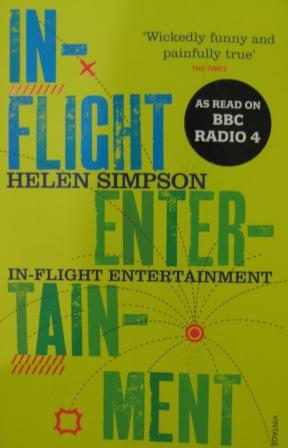 |
| 'In-Flight Entertainment' by Helen Simpson (Vintage, 2011) |
I've got to be honest, I struggled a bit with this book. I bought it because I'd been intrigued by 'Diary of an Interesting Year' (which has lost none of its power. Since re-reading it, I've found myself trying to be a bit less wasteful and a bit more environmentally friendly as I go about my business. There's not many stories that have snuck into my psyche like that!) and wanted something small and portable to take with me to read at a wedding (well, not at the actual wedding, obviously, but at the hotels the night before and night afterwards. Given the chance, I'd probably have filled the bags with books, so this was my attempt at being practical! Anyway...). I still feel it's a bit patchy and I felt more engaged by some stories than others (I've still no idea about 'The Tipping Point') and, sadly, I feel that the theme of environmental catastrophe was clumsily handled at times. It felt shoe-horned in in places and I felt a bit nagged really.
Looking at it now, though, I've realised that I actually enjoyed a lot more of it than I realised at the time. Also, I feel that a second reading when I've got fewer distractions might mean less of it flies over my head. To paraphrase the classic line, it's not the book, it's me.
I liked that some of these stories were a bit of a departure from others that I've read, focussed on more than relationships. 'Diary of an Interesting Year' is almost Science Fiction, while 'The Festival of the Immortals' was almost fantasy (well, for a book worm anyway!).
On the whole, I'd say this is not the best Helen Simpson book to start with, but I would recommend her as a writer to anyone, although her usual themes are likely to appeal more to a female audience. This is her fifth collection, so there are four others to try first. I've only read two, so don't feel I can recommend one just yet, although at least one Tweeter (Alex Griffith/@jalexgriffith ) praised 'Constitutional' when I mentioned it on Twitter. Perhaps that's the one I will go for next, once I've got a few more titles off the list!
Subscribe to:
Posts (Atom)