One of the few fun features of lockdown has been getting a look inside people's homes during video calls. After a short while, it became obvious that people were curating the rooms they broadcast from. "I'm a family man!" cried the wall of kids photos and crayon drawings. "I've got incredible taste!" boasted a minimalist display of just one, large, abstract artwork. "I'm an intellectual!" crowed bookcases of leather-bound classics. The only problem is that bookshelves cannot be trusted. As many well publicised surveys have proven over the past decade, not only are shelves littered with unread volumes, but people happily lie about reading some of the world's most prestigious works. George Orwell's infamous novel 'Nineteen Eighty-Four' is often listed among them - ironic for a book themed around truth.
Showing posts with label new. Show all posts
Showing posts with label new. Show all posts
19 July 2020
Ctrl Alt Delete: Back to Nineteen Eighty-Four
'Nineteen Eighty-Four' by George Orwell (Penguin Modern Classic edition, 2000)

28 July 2018
The Princess's Direst
I bet you thought it was safe here. I bet you thought that it would be easy to hide on a little book blog like this. Well, I'm sorry folks. You thought that only the cinema was dominated by Star Wars incarnations, but, like the many-tentacled Sarlacc, I'm afraid the popular space adventure's long, elasticated reach has made it into this little corner of the internet too. I have finished reading 'The Princess Diarist' by the late Carrie Fisher.
 'The Princess Diarist' is sub-titled 'A sort of memoir...' and that's a fairly accurate description. Unlike her other autobiographical work, it's dedicated to her relationship with the character of Princess Leia, Fisher's on-set affair with Harrison Ford and the unexpected impact of the worldwide phenomenon that Star Wars became and continues to be. The book's name comes from it's inspiration; a collection of journals that the 19-year-old Fisher wrote while filming the original Star Wars film in 1976. 'The Princess Diarist' is Fisher's reflection on her most famous role, how actor and character became almost indistinguishable in the popular imagination and the highs and lows that come with having such a huge hit so early in your career.

02 January 2017
Review of the Year 2016
Happy New Year, lovely readers! It's hard to believe that another 12 months has gone by already, but I'm afraid it has, so it's time to see how things are going. No burying my head in the sand!
Although I didn't scale the dizzy heights of 2014 (32 books read. 32!!), I have managed to reach my two books a month average this year. Half of these weren't on the original list, unfortunately, and I didn't always manage to blog about all of them, but I'm determined to do better in 2017. There are so many great books on my shelves, it's time to knuckle down and do them justice. Although I'll only be able to do this if the publishing industry stops being awesome and releasing amazing new books, of course. Such a dilemma!
To my surprise, I've read more fiction (14) than non-fiction (10) this year. If you'd have asked me, I would have told you that I'd read far more non-fiction, but it looks like I've been doing a better job of mixing things up than I realised. Although, having said that, five of the books were autobiographies by actors and celebrities, so perhaps not that mixed up... Will have to try and keep an eye on that next year.
So, my ideal reading list for 2017 would be longer, include more 'list' books and fewer autobiographies. It would also be great to get in a classic or two and some science fiction. Been a while since we've had some of that, so we'll have to see what we can do.
I would also love to see Benjamin Mee's follow up to 'We Bought a Zoo' on next year's list too, but two years after supporting the crowdfunding to help Dartmoor Zoo gain charitable status, the promised book still isn't finished. It's easy to forget that writing is a proper, full-time job, so it's not really a surprise that the guy is finding it hard to balance with running a zoo. Talk about multi-tasking.
I hope to keep working through Winston Graham's Poldark books next year too. Must keep ahead of the BBC series! Although they're such great books, I would definitely want to be reading them anyway. Good to have an incentive sometimes though!
While I'm still reading the Poldark series, I did actually finish another set of books in 2016; Ian Fleming's Bond novels. So even though I may not feel like I've achieved much this year, I have achieved that.
As always, thank you so much for your support and I do hope you're still enjoying the blog. To keep things interesting for you, I'm working on some posts about some great author-related places I've visited and hope to come up with some other book-related articles for you too. Watch this space!
It's always great to hear from you, so don't forget you can tweet me via @EileenFurze.
That's it for now, so all the best for 2017 and happy reading!
Reviews of the Year
2015
2014
2013
2012
2016: A Year in Books
January
'The Rendez-Vous and Other Stories' by Daphne Du Maurier
'Wishful Drinking' by Carrie Fisher
February
'To Kill A Mocking-Bird' by Harper Lee
March
'You Say Potato' by David and Ben Crystal
April
'Moranifesto' by Caitlin Moran
'Carmilla' by Joseph Sheridan Le Fanu
May
'Red: A Natural History of the Redhead' by Jacky Collis Harvey
June
'Gut' by Giulia Enders and Jill Enders
August
'The Swordfish and the Star' by Gavin Knight
'Spectacles' by Sue Perkins
September
'You Only Live Twice' by Ian Fleming
'The Man with the Golden Gun' by Ian Fleming
'The Heart Goes Last' by Margaret Atwood
'Miss Peregrine's Home for Peculiar Children' by Ransom Riggs
October
'Josephine' by Kate Williams
'Conclave' by Robert Harris
November
'The Four Swans' by Winston Graham
'On Her Majesty's Secret Service' by Ian Fleming
December
'No Cunning Plan' by Tony Robinson
'The Secret Diary of Adrian Mole Aged 13 3/4' by Sue Townsend
Although I didn't scale the dizzy heights of 2014 (32 books read. 32!!), I have managed to reach my two books a month average this year. Half of these weren't on the original list, unfortunately, and I didn't always manage to blog about all of them, but I'm determined to do better in 2017. There are so many great books on my shelves, it's time to knuckle down and do them justice. Although I'll only be able to do this if the publishing industry stops being awesome and releasing amazing new books, of course. Such a dilemma!
To my surprise, I've read more fiction (14) than non-fiction (10) this year. If you'd have asked me, I would have told you that I'd read far more non-fiction, but it looks like I've been doing a better job of mixing things up than I realised. Although, having said that, five of the books were autobiographies by actors and celebrities, so perhaps not that mixed up... Will have to try and keep an eye on that next year.
So, my ideal reading list for 2017 would be longer, include more 'list' books and fewer autobiographies. It would also be great to get in a classic or two and some science fiction. Been a while since we've had some of that, so we'll have to see what we can do.
I would also love to see Benjamin Mee's follow up to 'We Bought a Zoo' on next year's list too, but two years after supporting the crowdfunding to help Dartmoor Zoo gain charitable status, the promised book still isn't finished. It's easy to forget that writing is a proper, full-time job, so it's not really a surprise that the guy is finding it hard to balance with running a zoo. Talk about multi-tasking.
I hope to keep working through Winston Graham's Poldark books next year too. Must keep ahead of the BBC series! Although they're such great books, I would definitely want to be reading them anyway. Good to have an incentive sometimes though!
While I'm still reading the Poldark series, I did actually finish another set of books in 2016; Ian Fleming's Bond novels. So even though I may not feel like I've achieved much this year, I have achieved that.
As always, thank you so much for your support and I do hope you're still enjoying the blog. To keep things interesting for you, I'm working on some posts about some great author-related places I've visited and hope to come up with some other book-related articles for you too. Watch this space!
It's always great to hear from you, so don't forget you can tweet me via @EileenFurze.
That's it for now, so all the best for 2017 and happy reading!
Reviews of the Year
2015
2014
2013
2012
2016: A Year in Books
January
'The Rendez-Vous and Other Stories' by Daphne Du Maurier
'Wishful Drinking' by Carrie Fisher
February
'To Kill A Mocking-Bird' by Harper Lee
March
'You Say Potato' by David and Ben Crystal
April
'Moranifesto' by Caitlin Moran
'Carmilla' by Joseph Sheridan Le Fanu
May
'Red: A Natural History of the Redhead' by Jacky Collis Harvey
'Absolute Pandemonium' by Brian Blessed
'Not My Father's Son' by Alan Cumming
'The Black Moon' by Winston Graham
'Dead Man's Folly' by Agatha Christie
'Gut' by Giulia Enders and Jill Enders
August
'The Swordfish and the Star' by Gavin Knight
'Spectacles' by Sue Perkins
September
'You Only Live Twice' by Ian Fleming
'The Man with the Golden Gun' by Ian Fleming
'The Heart Goes Last' by Margaret Atwood
'Miss Peregrine's Home for Peculiar Children' by Ransom Riggs
October
'Josephine' by Kate Williams
'Conclave' by Robert Harris
November
'The Four Swans' by Winston Graham
'On Her Majesty's Secret Service' by Ian Fleming
December
'No Cunning Plan' by Tony Robinson
'The Secret Diary of Adrian Mole Aged 13 3/4' by Sue Townsend
13 August 2016
Curiously Contrasting Cornwall
I've loved visiting Cornwall ever since I can remember. Every year, millions of visitors are drawn to the county so picturesque it feels like it was designed by one of its many resident artisans. But alongside beautiful countryside and charming seaside towns, there are also the rugged moors and sharpened cliffs, tearing through land and sea from unseen depths. The contrasts in the landscape also show in the population; the fly-by-night holiday makers and weekend second homers existing alongside the tough, local fishermen, battle-hardened by decades at sea. Looking around at the ice cream chomping, sea gull dodging holiday crowds, you can't help but start wondering where the real Cornish are. These guys clearly have nothing to do with the boats in the harbour or the noise in the back street pubs. It's something that must've intrigued Gavin Knight too, as he's made the natives of Cornwall's Penwith Peninsular the subject of his latest book, the engrossing and atmospheric 'The Swordfish and the Star'.
'The Swordfish and the Star' lifts the lid on the Cornwall that's there all year round. It tells stories of the people who live and work there, who are both proud of the region's popularity, but rightfully resentful of the effect it's had on life in this corner of the country. The author has absorbed the interwoven histories of the innovative, the opportunistic, the commercial and the lost, of the dangerous, competitive and compelling draw of the sea, the age of the artists of St Ives and the hopes that technology may bring the area a future. Through these narratives, a picture is painted that helps us look beyond the sunshine and summer clichés and start to see a community that works hard and plays hard, even if we never knew it was there.
Although I found the writing style a bit hard to get used to at first (The author reflects the staccato, plain speaking style of many of his interviewees.), I absolutely fell in love with this book. It answered something I'd been curious about for a while and I'll never look at Cornwall, or indeed any coastal region, in the same way again.
I became absorbed in the lives of the people depicted and found myself rushing back to 'The Swordfish and the Star' at every opportunity to find out how they were getting on. I felt like I was sitting in one of the pubs of the title, listening to the banter and soaking up the atmosphere.
It's not all fun, however. 'The Swordfish and the Star' relates many tales of the dangers of a life in a seafaring community, of horrific injuries, vicious commercial rivalries, criminality and death. Believe me when I say you won't look at your cod and chips in the same way ever again. And I don't think that's a bad thing.
This is a book of contrasts and Cornwall is a county that is always hustling, always looking for that next opportunity so it can keep its head above water and stop its young people from ebbing away as they have to find work elsewhere. As well as tales of the risks and rewards offered by a career in the fishing industry, Mr Knight explores the potential provided by innovative companies and new technologies that are opening up a virtual world of possibilities.
Overall, I thoroughly enjoyed 'The Swordfish and the Star'. It rescues Cornwall from its Brigadoon-esque role - there during the summer months, then out of sight and out of mind the rest of the year except in memory and literature. If you're the curious sort who has also wondered what goes on when the tourists have left, then I reckon you will enjoy this book too.
 |
| 'The Swordfish and the Star' by Gavin David (Chatto & Windus, 2016) |
Although I found the writing style a bit hard to get used to at first (The author reflects the staccato, plain speaking style of many of his interviewees.), I absolutely fell in love with this book. It answered something I'd been curious about for a while and I'll never look at Cornwall, or indeed any coastal region, in the same way again.
I became absorbed in the lives of the people depicted and found myself rushing back to 'The Swordfish and the Star' at every opportunity to find out how they were getting on. I felt like I was sitting in one of the pubs of the title, listening to the banter and soaking up the atmosphere.
It's not all fun, however. 'The Swordfish and the Star' relates many tales of the dangers of a life in a seafaring community, of horrific injuries, vicious commercial rivalries, criminality and death. Believe me when I say you won't look at your cod and chips in the same way ever again. And I don't think that's a bad thing.
This is a book of contrasts and Cornwall is a county that is always hustling, always looking for that next opportunity so it can keep its head above water and stop its young people from ebbing away as they have to find work elsewhere. As well as tales of the risks and rewards offered by a career in the fishing industry, Mr Knight explores the potential provided by innovative companies and new technologies that are opening up a virtual world of possibilities.
Overall, I thoroughly enjoyed 'The Swordfish and the Star'. It rescues Cornwall from its Brigadoon-esque role - there during the summer months, then out of sight and out of mind the rest of the year except in memory and literature. If you're the curious sort who has also wondered what goes on when the tourists have left, then I reckon you will enjoy this book too.
01 August 2014
Shooting from the Hip
A few weeks ago, the lovely people at Blinding Books were kind enough to send me a copy of 'My Baby Shot Me Down', an anthology of poetry and prose by ten women writers. Now, I know I shouldn't really stray from my list, but they asked so nicely. And I love a good short story.
'My Baby Shot Me Down' features the work of Clarissa Angus, Katherine Black, Maggy van Eijk, Harriet Goodale, Deborah Hambrook, Claudine Lazar, Rachael Smart, Ruth Starling, Alison Wassell and Laura Wilkinson. Some are award winners, but all could be described as up-and-coming writers. The selected pieces range from the tragic to the poignant to the funny and capture the lives of women and girls of all ages.
OK, confession time. I didn't read all of this book. Now you've picked yourselves up off of the floor, here's why. I've never really understood poetry and, despite the best efforts of my school teachers, find it a completely alien language that is impenetrable to me. It's not the poet's fault at all and no reflection on the quality of the work in 'My Baby Shot Me Down', but after a couple of attempts I did skip all the poetry in this volume to focus on the work I could enjoy.
I do absolutely love short stories and this book includes a number of memorable examples. They range from the bitterly funny 'A Game to Play', about how to be an (im)perfect man, and 'The Great Escape', the tale of how institutional help can hinder, to the chilling 'The Whispering Wall' and 'Mr Brown'. 'Ashes' and 'Love and App-iness' made me laugh, while 'We'll Meet Again' and 'Tissue Atlas' made me cry. 'Buried' reminded me of summers long ago. 'Supermarket Secrets' made me realise how rare it is to read about ordinary women in more ordinary jobs rather than journalists, actors, lawyers and PRs.
Overall, this book is great as a showcase for not-quite-discovered writing talent, demonstrating depth and breadth as well as bringing to the fore themes that women in particular can relate to. Although some of the flash fiction felt a bit too short, the book is certainly thought provoking. I suddenly realised after reading 'Supermarket Secrets' that I couldn't think of any other piece of fiction set in a supermarket, which is odd when you consider how many people work in them and how ubiquitous they are. It also got me wondering about the way book genres work. I know I read an awful lot of historical fiction and not nearly enough modern books, but am I imagining the disproportionate number of strong women in the former? Only reading my 500-odd books will tell!
This anthology worked its magic enough for me to want to buy other work by these authors. They are certainly names to watch and I would recommend 'My Baby Shot Me Down' to anyone keen to try something new.
 |
| 'My Baby Shot Me Down' by Various Authors (Blinding Books, 2014) |
OK, confession time. I didn't read all of this book. Now you've picked yourselves up off of the floor, here's why. I've never really understood poetry and, despite the best efforts of my school teachers, find it a completely alien language that is impenetrable to me. It's not the poet's fault at all and no reflection on the quality of the work in 'My Baby Shot Me Down', but after a couple of attempts I did skip all the poetry in this volume to focus on the work I could enjoy.
I do absolutely love short stories and this book includes a number of memorable examples. They range from the bitterly funny 'A Game to Play', about how to be an (im)perfect man, and 'The Great Escape', the tale of how institutional help can hinder, to the chilling 'The Whispering Wall' and 'Mr Brown'. 'Ashes' and 'Love and App-iness' made me laugh, while 'We'll Meet Again' and 'Tissue Atlas' made me cry. 'Buried' reminded me of summers long ago. 'Supermarket Secrets' made me realise how rare it is to read about ordinary women in more ordinary jobs rather than journalists, actors, lawyers and PRs.
Overall, this book is great as a showcase for not-quite-discovered writing talent, demonstrating depth and breadth as well as bringing to the fore themes that women in particular can relate to. Although some of the flash fiction felt a bit too short, the book is certainly thought provoking. I suddenly realised after reading 'Supermarket Secrets' that I couldn't think of any other piece of fiction set in a supermarket, which is odd when you consider how many people work in them and how ubiquitous they are. It also got me wondering about the way book genres work. I know I read an awful lot of historical fiction and not nearly enough modern books, but am I imagining the disproportionate number of strong women in the former? Only reading my 500-odd books will tell!
This anthology worked its magic enough for me to want to buy other work by these authors. They are certainly names to watch and I would recommend 'My Baby Shot Me Down' to anyone keen to try something new.
17 March 2014
Caught between the Devil and the Marshalsea...
Late last year, I knew I'd had a bit more time on my hands than usual, so applied for a couple of prize draws on the Waterstones website. Last weekend, two books turned up... Whoops.
The first arrival was absorbing historical crime novel 'The Devil in the Marshalsea', Antonia Hodgson's first book.
Tom Hawkins is in the worst possible trouble. Unable to resist the lure of London, its coffeehouses, brothels and gambling dens, relying luck and living life to the full, he finds himself not just penniless but in debt and heading towards the feared Marshalsea debtors' prison. Estranged from his vicar father, not knowing who to trust and reliant on his best friend Charles Buckley, he soon realises he has no hope of raising either the money to pay his debt or fund his stay in the Master's side of the prison. Just as he thinks all hope is lost and he is destined for death from jail fever in the Common Side, Hawkins is thrown a lifeline. A murder has taken place at the Marshalsea and Buckley's rich patron promises Hawkins his freedom if he finds the killer. But to do so, he must negotiate the prison's complex web of truth, lies and alliances. Can he do it before he becomes the Marshalsea's latest victim?
To begin with, I absolutely loved 'The Devil in the Marshalsea'. Ms Hodgson has used her research well and did a fantastic job of evoking this time and a place. Equally, Hawkins is an easy character to become attached to. He's impulsive and flawed but hard not to like and identify with. After all, we're all only human.
Although I felt that this was a good read overall, I felt that the ending was disappointing. I can't go into detail because I don't want to give away the mystery at the heart of the novel, but I felt that both the murderer and motive were a bit cliched and disappointing after such a well crafted set up. I say cliched because it seems that the murderer has two attributes that keep reappearing in TV crime dramas and seem to say more about modern attitudes than having anything to do with good plotting. What happened to the good old days when characters killed each other for lust, greed or revenge?
It took me a while to work out what the other thing that bothered me was. Quite near the end of the book, as Hawkins looses all faith and becomes dehumanised by the brutality he has both seen and suffered, he begins to change quite dramatically. By the end of the book, however, he seems to have forgotten what he's been through and back to his happy-go-lucky ways, neither looking back nor thinking what he might be able to do to help those left behind, even on the ghastly Common Side of the prison. I could understand a character just wanting to run away and leave the Marshalsea and its inhabitants behind a mental as well as physical locked door, but I just found it hard to believe someone who is supposed to be "honourable" would not in the very least want to do something to help those still trapped in the notorious prison, even if they couldn't do much.
Overall, I think this book is let down by the ending, which is a real shame, especially as the writer is such a friendly presence on Twitter. Putting the ending to one side, 'The Devil in the Marshalsea' was well written, absorbing and taught me about a time and place I wouldn't have otherwise visited. I certainly hope to see more from this writer and hope that there is much better to come.
The first arrival was absorbing historical crime novel 'The Devil in the Marshalsea', Antonia Hodgson's first book.
 |
| 'The Devil in the Marshalsea' by Antonia Hodgson (Hodder & Stoughton, 2014) |
To begin with, I absolutely loved 'The Devil in the Marshalsea'. Ms Hodgson has used her research well and did a fantastic job of evoking this time and a place. Equally, Hawkins is an easy character to become attached to. He's impulsive and flawed but hard not to like and identify with. After all, we're all only human.
Although I felt that this was a good read overall, I felt that the ending was disappointing. I can't go into detail because I don't want to give away the mystery at the heart of the novel, but I felt that both the murderer and motive were a bit cliched and disappointing after such a well crafted set up. I say cliched because it seems that the murderer has two attributes that keep reappearing in TV crime dramas and seem to say more about modern attitudes than having anything to do with good plotting. What happened to the good old days when characters killed each other for lust, greed or revenge?
It took me a while to work out what the other thing that bothered me was. Quite near the end of the book, as Hawkins looses all faith and becomes dehumanised by the brutality he has both seen and suffered, he begins to change quite dramatically. By the end of the book, however, he seems to have forgotten what he's been through and back to his happy-go-lucky ways, neither looking back nor thinking what he might be able to do to help those left behind, even on the ghastly Common Side of the prison. I could understand a character just wanting to run away and leave the Marshalsea and its inhabitants behind a mental as well as physical locked door, but I just found it hard to believe someone who is supposed to be "honourable" would not in the very least want to do something to help those still trapped in the notorious prison, even if they couldn't do much.
Overall, I think this book is let down by the ending, which is a real shame, especially as the writer is such a friendly presence on Twitter. Putting the ending to one side, 'The Devil in the Marshalsea' was well written, absorbing and taught me about a time and place I wouldn't have otherwise visited. I certainly hope to see more from this writer and hope that there is much better to come.
24 September 2013
The Ballad of Zeb and Toby
I've just finished the recently published 'MaddAddam' by Margaret Atwood, the last in the superlative 'Oryx and Crake' trilogy. Must've been good for me to finish it in just a week!
'MaddAddam' begins as 'The Year of the Flood' ends. The human race has been largely wiped out by a mysterious virus, but a handful of outsiders have survived. Many are former God's Gardeners, a Christian Environmental sect that values nature and cultivates self-reliance, or members of MaddAddam, a terrorist group that dispensed with the Gardener's pacifism and used genetic know-how to cause disruption to the ruling corporations. But they are not the only people left alive. Two psychotic competitors from the Painball games have escaped the plague and want nothing more than to torture, rape and kill. Having saved Amanda from them once, with the help of Ren and the unexpected arrival of Snowman-the-Jimmy, Toby lets down her guard and the Painballers escape. Will Toby and the other survivors find them before it's too late? How can they protect the innocent Children of Crake? And what of the mysterious Zeb?
Atwood has pulled off a fantastic hat trick with these three books and 'MaddAddam' is the captivating conclusion to a thrilling trilogy. While books one and two told the stories of Glenn, Jimmy, Ren and Toby, here we find out about the enigmatic Zeb and spend more time with the Children of Crake, the genetically modified replacement for human beings. Once again, Atwood juggles the varied voices involved fantastically and it's easy to forget that they all come from the mind of one author.
'MaddAddam' is probably the most surreal and fanciful of the three books, but it is set after the apocalypse and feels right for the world that Atwood has created. Or should I say predicted?
The ending did leave me feeling bereft, but, as any reader will tell you, that's not unusual when you've enjoyed a book and grown attached to the characters involved.
Overall, I would really recommend the Oryx and Crake trilogy to anyone who enjoys thought provoking books which challenge the way we see the world. This is Speculative, rather than Science, Fiction at its best.
Now, back to Bernard Cornwell's Saxons vs Danes Round Five: Pride Comes Before a Fall. I'm only on page 48 and I think I can see where this is going! Really don't mind though. Honest.
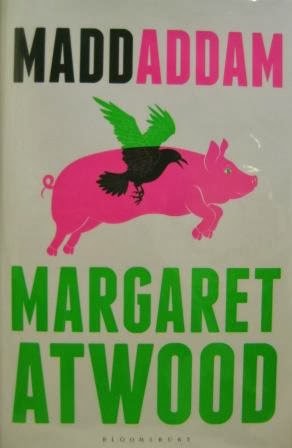 |
| 'MaddAddam' by Margaret Atwood (Bloomsbury, 2013) |
Atwood has pulled off a fantastic hat trick with these three books and 'MaddAddam' is the captivating conclusion to a thrilling trilogy. While books one and two told the stories of Glenn, Jimmy, Ren and Toby, here we find out about the enigmatic Zeb and spend more time with the Children of Crake, the genetically modified replacement for human beings. Once again, Atwood juggles the varied voices involved fantastically and it's easy to forget that they all come from the mind of one author.
'MaddAddam' is probably the most surreal and fanciful of the three books, but it is set after the apocalypse and feels right for the world that Atwood has created. Or should I say predicted?
The ending did leave me feeling bereft, but, as any reader will tell you, that's not unusual when you've enjoyed a book and grown attached to the characters involved.
Overall, I would really recommend the Oryx and Crake trilogy to anyone who enjoys thought provoking books which challenge the way we see the world. This is Speculative, rather than Science, Fiction at its best.
Now, back to Bernard Cornwell's Saxons vs Danes Round Five: Pride Comes Before a Fall. I'm only on page 48 and I think I can see where this is going! Really don't mind though. Honest.
09 September 2012
Going Walkabout
This morning, I finished 'The Unlikely Pilgrimage of Harold Fry' by Rachel Joyce. Unusually for me, this is a relatively recent publication (this year). I saw it reviewed in a weekend newspaper and decided to check it out of the library. Within a few pages, I was hooked and desperate to hitch a ride with the unexpected traveller, which is how come it became a new addition to the list.
Harold Fry's unlikely pilgrimage begins with a letter from an old colleague, Queenie Hennessy, delivered to his South Devon home. Dying of cancer in a Berwick-Upon-Tweed hospice in the far north east of England, Queenie has written to say a final goodbye. Harold is surprised to hear from her after 20 years absence from his life, but writes a reply to take to the post box. As he walks, however, he realises that something doesn't feel right. His written words aren't enough, but he doesn't know what else to do. Then a chance encounter with a sales assistant at a petrol station inspires him to do something remarkable; to leave his wife, his home and the predictable mundanity of his retired life and walk to Berwick, all in the hope that Queenie will live after all.
This book begins with a comi-tragic tone which makes it hard not to fall completely in love with Harold and root for him from the start. The first chapters describe lives and settings I feel so familiar with it gave me chills to see them described in print. Perhaps I've been reading too much science fiction lately, but I can't remember the last time I read a story set somewhere that felt so familiar! I also know quite a few of the locations Harold visited, which perhaps made it easier to sink into the story.
The beautiful simplicity of the plot is a smokescreen for a more complicated, moving and heart wrenching tale of regret, misunderstanding and the everyday reality of love. Only readers with a heart of flint could read this book and not shed a tear as the truth of Harold's less than happy life and relationships with Queenie, his son David and his wife Maureen become clear during his journey.
Although I suspected the truth about David from the start, it by no means took away from the narrative. Once my affection for Harold was established, I found I couldn't put the book down because I was so worried about whether he would be alright. But then, I am quite a softy.
On the whole, I felt this was a beautiful, engaging, moving book which will definitely be given to a few people as a present, but probably more likely to appeal to a female rather than a male audience. I would love to know what men who read it did think, though, as I fear I may be doing them a disservice.
Although a seasoned writer of radio plays, I understand that this was Ms Joyce's first novel. I will be keeping my eyes out for her second.
Now, back to the shelves. Where to next..?
Harold Fry's unlikely pilgrimage begins with a letter from an old colleague, Queenie Hennessy, delivered to his South Devon home. Dying of cancer in a Berwick-Upon-Tweed hospice in the far north east of England, Queenie has written to say a final goodbye. Harold is surprised to hear from her after 20 years absence from his life, but writes a reply to take to the post box. As he walks, however, he realises that something doesn't feel right. His written words aren't enough, but he doesn't know what else to do. Then a chance encounter with a sales assistant at a petrol station inspires him to do something remarkable; to leave his wife, his home and the predictable mundanity of his retired life and walk to Berwick, all in the hope that Queenie will live after all.
This book begins with a comi-tragic tone which makes it hard not to fall completely in love with Harold and root for him from the start. The first chapters describe lives and settings I feel so familiar with it gave me chills to see them described in print. Perhaps I've been reading too much science fiction lately, but I can't remember the last time I read a story set somewhere that felt so familiar! I also know quite a few of the locations Harold visited, which perhaps made it easier to sink into the story.
The beautiful simplicity of the plot is a smokescreen for a more complicated, moving and heart wrenching tale of regret, misunderstanding and the everyday reality of love. Only readers with a heart of flint could read this book and not shed a tear as the truth of Harold's less than happy life and relationships with Queenie, his son David and his wife Maureen become clear during his journey.
Although I suspected the truth about David from the start, it by no means took away from the narrative. Once my affection for Harold was established, I found I couldn't put the book down because I was so worried about whether he would be alright. But then, I am quite a softy.
On the whole, I felt this was a beautiful, engaging, moving book which will definitely be given to a few people as a present, but probably more likely to appeal to a female rather than a male audience. I would love to know what men who read it did think, though, as I fear I may be doing them a disservice.
Although a seasoned writer of radio plays, I understand that this was Ms Joyce's first novel. I will be keeping my eyes out for her second.
Now, back to the shelves. Where to next..?
Subscribe to:
Posts (Atom)