22 September 2012

We Apologise for the Delay...

Alright, alright, I'm sorry!  I know I've been a bit rubbish this week and taken several days to get around to writing this post.  It's just been one of those weeks where time is in very short supply.

Time being in short supply is a bit of a theme for the latest book I've read, 'In-Flight Entertainment' by master short story writer Helen Simpson.  This is the third book of Ms Simpson's short stories that I've read, after 'Hey Yeah Right Get a Life' and 'Dear George and Other Stories'.  I first found out about her when I read the chilling 'Diary of an Interesting Year' in a weekend newspaper, a story which is included in this collection.
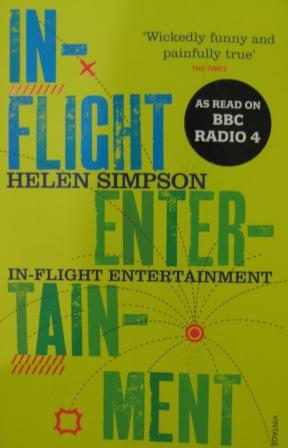
'In-Flight Entertainment'
by Helen Simpson
(Vintage, 2011)
'In-Flight Entertainment' contains 15 short stories mostly connected by the theme of impending doom due to global warming and humanity's tendency to bury its head in the sand.  The stories include 'Diary of an Interesting Year', a story of survival after environmental catastrophe, the claustrophobic 'In-Flight Entertainment', charting the shifting discomfort of an air passenger as he converses with a fellow traveller, 'Channel 17', which captures snapshots of the relationships of hotel occupants, and 'I'm Sorry But I'll Have to Let You Go', a tale of cold hearted idiocy.

I've got to be honest, I struggled a bit with this book.  I bought it because I'd been intrigued by 'Diary of an Interesting Year' (which has lost none of its power.  Since re-reading it, I've found myself trying to be a bit less wasteful and a bit more environmentally friendly as I go about my business.  There's not many stories that have snuck into my psyche like that!) and wanted something small and portable to take with me to read at a wedding (well, not at the actual wedding, obviously, but at the hotels the night before and night afterwards.  Given the chance, I'd probably have filled the bags with books, so this was my attempt at being practical!  Anyway...).  I still feel it's a bit patchy and I felt more engaged by some stories than others (I've still no idea about 'The Tipping Point') and, sadly, I feel that the theme of environmental catastrophe was clumsily handled at times.  It felt shoe-horned in in places and I felt a bit nagged really.

Looking at it now, though, I've realised that I actually enjoyed a lot more of it than I realised at the time.  Also, I feel that a second reading when I've got fewer distractions might mean less of it flies over my head.  To paraphrase the classic line, it's not the book, it's me.

I liked that some of these stories were a bit of a departure from others that I've read, focussed on more than relationships.  'Diary of an Interesting Year' is almost Science Fiction, while 'The Festival of the Immortals' was almost fantasy (well, for a book worm anyway!).

On the whole, I'd say this is not the best Helen Simpson book to start with, but I would recommend her as a writer to anyone, although her usual themes are likely to appeal more to a female audience.  This is her fifth collection, so there are four others to try first.  I've only read two, so don't feel I can recommend one just yet, although at least one Tweeter (Alex Griffith/@jalexgriffith ) praised 'Constitutional' when I mentioned it on Twitter.  Perhaps that's the one I will go for next, once I've got a few more titles off the list!

09 September 2012

Going Walkabout

This morning, I finished 'The Unlikely Pilgrimage of Harold Fry' by Rachel Joyce.  Unusually for me, this is a relatively recent publication (this year).  I saw it reviewed in a weekend newspaper and decided to check it out of the library.  Within a few pages, I was hooked and desperate to hitch a ride with the unexpected traveller, which is how come it became a new addition to the list.

Harold Fry's unlikely pilgrimage begins with a letter from an old colleague, Queenie Hennessy, delivered to his South Devon home.  Dying of cancer in a Berwick-Upon-Tweed hospice in the far north east of England, Queenie has written to say a final goodbye.  Harold is surprised to hear from her after 20 years absence from his life, but writes a reply to take to the post box.  As he walks, however, he realises that something doesn't feel right.  His written words aren't enough, but he doesn't know what else to do.  Then a chance encounter with a sales assistant at a petrol station inspires him to do something remarkable; to leave his wife, his home and the predictable mundanity of his retired life and walk to Berwick, all in the hope that Queenie will live after all.

This book begins with a comi-tragic tone which makes it hard not to fall completely in love with Harold and root for him from the start.  The first chapters describe lives and settings I feel so familiar with it gave me chills to see them described in print.  Perhaps I've been reading too much science fiction lately, but I can't remember the last time I read a story set somewhere that felt so familiar!  I also know quite a few of the locations Harold visited, which perhaps made it easier to sink into the story.

The beautiful simplicity of the plot is a smokescreen for a more complicated, moving and heart wrenching tale of regret, misunderstanding and the everyday reality of love.  Only readers with a heart of flint could read this book and not shed a tear as the truth of Harold's less than happy life and relationships with Queenie, his son David and his wife Maureen become clear during his journey.

Although I suspected the truth about David from the start, it by no means took away from the narrative.  Once my affection for Harold was established, I found I couldn't put the book down because I was so worried about whether he would be alright.  But then, I am quite a softy.

On the whole, I felt this was a beautiful, engaging, moving book which will definitely be given to a few people as a present, but probably more likely to appeal to a female rather than a male audience.  I would love to know what men who read it did think, though, as I fear I may be doing them a disservice.

Although a seasoned writer of radio plays, I understand that this was Ms Joyce's first novel.  I will be keeping my eyes out for her second.

Now, back to the shelves.  Where to next..?

23 August 2012

There's Something at the Bottom of the Garden...

I'm never going into a garden again and if you think I'll look at any future eclipses or other astronomical events, you've got another thing coming!

As you might be able to guess, I've just finished John Wyndham's 'The Day of the Triffids', probably the best known of this British author's novels. 

'The Day of the Triffids' is a story of human survival in the midst of a terrifying worldwide apocalypse.  Bill Mason wakes in a London hospital, his eyes bandaged following eye treatment.  Confused and frightened by the lack of normal noise either in the hospital or outside his window, he cautiously removes the dressings and finds himself in the middle of a living nightmare.  A 'meteorite' storm the previous night has blinded most of the world's population and, as he travels through London in shock, Bill finds that life as he knew it has gone for good.  As he begins to encounter other survivors, he realises that the catastrophe has often brought out the worst in people.  As the remaining population begins to find ways to group and cope with the new circumstances, a new, terrible threat emerges - the determined, devious and deadly Triffids...

Now, first things first.  There was one part of this book that made me very, very irritated.  One group of intellectualised survivors band together at a London university.  One of the earliest things they do is call a meeting at which an eminent Sociologist talks about the future of society and how it will be necessary to leave elements of the old moral framework, behind for practical reasons.  Fair enough.  But why is sex their main priority when they haven't even found a safe way out of London yet?  London, which is already littered with suicides and brutal gangs and already a breeding ground for disease?  And when they only have one, shy nurse to provide pre- and postnatal care?!

I can only assume that when this book was written in the 1950s, talking about sanctioned sexual promiscuity was terribly, terribly shocking in a way it simply isn't today.  Then it would sort of make sense.  But to my modern (female) eyes, it just seemed like putting the cart before the horse.  No point in having babies if you can't feed them or keep them safe, even if you are trying to save mankind.

On the whole though, this book is a real page turner, a brilliant combination of horror, socio-political comment and old fashioned adventure.  It did get a bit preachy in places, particularly when an idealistic but impulsive character called Coker comes on the scene, but I think I understood most of the comparisons the author was drawing with different political ideologies.

I know I shouldn't be, but it still surprises me how relevant the science fiction of the last century still is.  'The Day of the Triffids' could be read as socio-political comment, environmental parable or analysis of how we might cope with extreme disaster.  As a result, it's incredibly interesting as well as entertaining.

And, of course, you have a fantastic villain: The Triffids.  Human beings may have had a hand in creating their predicament, but the constant and escalating onslaughts by the seven foot tall, alien-looking plants really is a danger all its own.  They're clever, they're everywhere and they're topped with lightening-quick stings which can kill a man several feet away.  As I say, Prince Charming can do the gardening from now on!

'The Day of the Triffids' begins with probably one of the most famous opening lines ever.  Striking the reader like a slap across the face from the start, the book doesn't let up at any point.  Before you know it, you've turned the last page... And you're wondering whether that rustling really is just the breeze through the trees.  Shudder!