19 July 2012

The Mad Flappers' Cocktail Party

I've just finished reading 'The Great Gatsby' by F. Scott Fitzgerald and my mind has been buzzing ever since.  Mainly with '80s pop songs which somehow relate to the plot ('Tell me lies, tell me sweet little lies...'), but anyhoo...

Set in 1920s New York at the height of the crazy Jazz Age, 'The Great Gatsby' is a fable about obsession - obsession with money, status and decadent living.  Inspired by aspects of Fitzgerald's own life, the book is narrated by Nick Carraway, who moves to West Egg, Long Island, so he can work in the city.  At first he's intrigued by his enigmatic neighbour, the eponymous Jay Gatsby, but as the truth and lies of Gatsby's life begin to unravel and Carraway finds himself caught up in terrible events beyond his control, he rapidly realises things are not what they appeared.  Far from being a staid, sober, man-in-charge, Gatsby is in the thrall of of the flighty, upper class Daisy Buchanan, cousin to Carraway, inhabitant of the fashionable East Egg and wife to the brutish Tom.
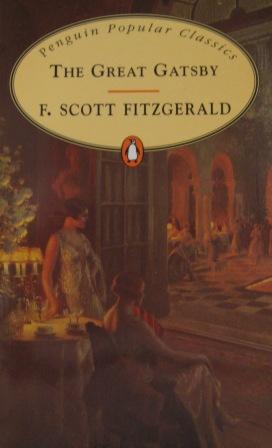
'The Great Gatsby' by
F. Scott Fitzgerald
(Penguin Popular Classics,  1994)
I've read a few of Fitzgerald's short stories and absolutely love the way he describes and gets right into the heads of his characters.  His people are layered and their moods and morality change and shift, making them incredibly interesting.  I wasn't sure how this would translate to a novel, but I'm glad to say this feature of Fitzgerald's writing remains and is key to the story.

Much like its title character, this book is deceptive.  It's less than 200 pages long and has quite a ostensibly simple plot, but the more I've thought about it, the more I've realised how clever it is.  'The Great Gatsby' is often described as a classic of American literature, but don't let that put you off.  Far from deifying the 'American way', it actually breaks it down to a personal level and shows the harm the influence of a feckless, irresponsible upper class can do.  In an age of debt-inducing consumerism and all encompassing celebrity culture, this book's message still resonates today.

Overall, I would recommend this book.  It works on several levels - as a story, as a mystery, as a comment on society - and I think many readers would get a lot out of the experience.  For me, it's the continuation of what I hope will be a beautiful friendship and I hope to spend a lot more time on the couch following Fitzgerald into the consciousness of his characters in the future.

08 July 2012

Handle with Care

I've just finished reading 'Fragile Things', a collection of short stories and poems by one of my all time favourite writers, Neil Gaiman.

'Fragile Things' by
Neil Gaiman (Headline
Review, 2006)
'Fragile Things' is an eclectic parcel of work which, typically for Gaiman, is hard to pigeon hole, even for the sake of review.  Some stories verge on science fiction (e.g. the Holmesian 'A Study in Emerald' and 'Goliath', a story from the world of 'The Matrix'), while others are funny (such as 'Forbidden Brides of the Faceless Slaves in the Secret House of the Night of Dread Desire').  Some resemble classically eerie ghost tales (like 'October in the Chair' and 'Closing Time'), others disturbing crime stories (e.g. 'Keepsakes and Treasures' featuring the kind of influential characters I really hope don't exist in real life) and the nightmarishly frightening (including 'Feeders and Eaters' and 'The Flints of Memory Lane'.  The former will definitely stay with me a long time, which is weird because it's creepy rather than horrific!).  The collection ends with a novella called 'The Monarch of the Glen', a companion piece to Gaiman's fantastic novel 'American Gods', which draws upon Ancient Norse mythology and doesn't shy away from ratcheting up the tension!

Although I've not read any of his graphic novels, I have read and enjoyed all of Mr Gaiman's adult fiction and his last collection of shorts, 'Smoke and Mirrors'.  To me, 'Fragile Things' felt a lot darker and more haunting than the other books I've read and made me wish I was all wrapped up in bed, safe and sound at times!  Not that being creeped out by what I'm reading is a bad thing.  In fact, it's arguably right on the Zeitgeist for a summer of perpetual rain, which feels more like November than July!

Overall, Mr Gaiman has once again successfully put his unique stamp on a range of niche genres here, delivering many stories which will stay with me for a very long time and for the right reasons.  I'd recommend 'Fragile Things' as something for fans of Science Fiction, Horror and Gothic ghost stories to try, but I wouldn't guarantee that everyone will like every story or poem!  Ultimately, it comes down to more than just genre - it's about the whole package, whether you like Mr Gaiman as a writer, his style and the way he thinks.

Gaiman fans will find much to enjoy here, although be careful you don't get caught out by the darker tone of this volume.  The fact 'Fragile Things' is short fiction also means it's a great opportunity for genre fans to open it up and taking their pick of what's inside.  Don't have nightmares now!

07 July 2012

The Art of Reading

I had a lovely visit to the city of Chichester in West Sussex recently and was delighted to find an exhibition of Philip Jackson's imposing sculptures on display in the cathedral precincts.  Reading is such a personal experience that I'm always fascinated when artists use their talents to express it visually, so I was particularly drawn to a number of Mr Jackson's amazing creations:

'Reading Chaucer'

'Guided Missal'

'Guided Missal' in close up.

'Chanting Cimaosa' (I know it's not strictly reading, but I couldn't resist!)


'Chanting Cimarosa' in close up.


'Mr Bennet's Daughter'.  Can't imagine what that's a reference to!


The exhibition is on from 25 June 2012 to 28 July 2012 in the cloisters of Chichester Cathedral.  Don't miss out on this wonderful collection of work!

For more images of Mr Jackson's sculpture, visit his website:  http://www.philipjacksonsculptures.co.uk/ .