28 September 2014

Treasure Trove

Considering I'm trying to read so many books, I think I've been pretty lucky so far.  I've only found a handful so unbearable that I've not finished them and have unearthed so many hidden gems that the project has often been a delight.

One such brilliant discovery is the latest book sent to me by Waterstones, 'Love and Treasure' by American author Ayelet Waldman.

'Love and Treasure' is the story of a stunning peacock-shaped pendant, three remarkable women and
'Love and Treasure'
by Ayelet Waldman
(Two Roads, 2014)
the men who loved them.  Interwoven with key political and social shifts in the last 100 years, this excellent book is set in three eras.  In 1945, the jewel is found by American soldier Captain Jack Wiseman among the vast contents of the Hungarian Gold Train, stolen from the Jews during World War II and now under his care.  As he falls in love with the determined concentration camp survivor Ilona, Jack finds himself torn between his personal sense of justice, the demands of his distant superiors and how unlikely the property can be returned to its rightful owners.  More than 60 years later, Wiseman's granddaughter, Natalie, has joined forces with Amitai Shasho, a specialist dealer in items seized by the Nazis, to return the unique jewel.  Amitai has recognised the piece from a lost painting he has spent a lifetime tracing. Together, they hope to find both the owner's descendants and the elusive artwork.  Finally, in 1913, a strong-minded young woman in Budapest is sent to a pioneering psychoanalyst after defying her family and pursuing her dream of a medical career.  A campaigner for women's suffrage, her passion and politics lead her into danger.  But how is she connected with the peacock pendant?

I found 'Love and Treasure' a fascinating page turner and incredibly hard to put down.  I was very sad to finish it.  I knew nothing about the Hungarian Gold Train before I started reading the novel and would now very much like to know more about it and this time period.  I always enjoy a book which lets me learn something new.

I felt that the part set in post-war Salzburg was the strongest, but moving between different times helped remind the reader that the dramatic events of one era often have their origins many years before and will cause ripples long into the future.  That is why history is important; it helps us understand why things are as they are and where they could lead.

The author has successfully written people not just characters, each with complex motivations and beliefs that felt authentic to their time period, no matter how ridiculous they look through 21st century eyes.  No-one could be classed wholly as a hero or villain, but all are conflicted and often naive and confused, trying to make good moral choices and judgements is a less than honourable world.  They were often torn between the just and the practical and it was easy to find yourself wondering what you'd do in the same situation.

My only criticism of 'Love and Treasure' is that I felt it needed some minor adaptation for the UK market, perhaps in the form of an added glossary.  Aspects of Jewish culture are not so well known here and I regularly had to reach for the dictionary to look things up, which obviously interrupted the narrative's flow.  Basically, a certain level of prior knowledge was presumed and, while US readers must be better informed on the subject, I think ordinary UK readers may struggle.

Overall, I thoroughly recommend this book and I hope to read more by this author in the future.  It is indeed a novel to love and treasure.

Now for something completely different!

23 September 2014

Thunderstruck

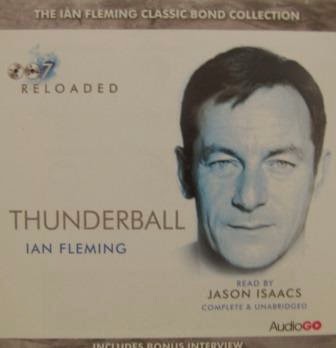
I recently finished listening to AudioGo's 007 Reloaded version of 'Thunderball' by Ian Fleming, read by Jason Isaacs. Talk about thunderstruck!

'Thunderball' by Ian Fleming
Read by Jason Isaacs
(AudioGO, 2012)
Arch-conspirator and head of SPECTRE Ernst Stavro Blofeld has engineered the capture of two atomic weapons and has his sights set on extortion.  The UK and US governments must pay up £100 million, otherwise two unidentified locations will be destroyed and chaos will ensue.  With just one week to find the bombs and prevent worldwide disaster, M sends his top secret agent, James Bond, into battle once more...

I absolutely loved this audiobook.  It amazes me, but Fleming seems to do something different with every Bond story, as though he's constantly trying different styles and structures.  Here, for example, he juggles a lot of seemingly unconnected plotlines that are, of course, very much entwined, skillfully drip feeding their relevance to the reader at just the right moment.  So pay attention, 007!

This book is also interesting from a Bond mythos perspective.  It has a lot of background information about 007's arch-nemesis Blofeld and we get some glimpses into the more everyday life led by the jobbing secret agent.

'Thunderball' by Ian Fleming
(Penguin Modern Classics, 2004)
There is, of course, also all the standard items you'd expect in any Bond book worthy of the name; exotic location (Bahamas), feisty female lead (Domino), a villain to defeat (Emilio Largo), rich living (the super-yacht the Disco Volante).  There's also the usual sex and violence and, perhaps surprisingly, humour.  There were parts of the first few chapters that actually made me laugh aloud, not something I would've predicted!

Jason Isaacs did a fantastic job of reading 'Thunderball' and I think his contribution to how much I enjoyed this audiobook shouldn't be ignored.  I shall definitely be looking out for other work read by him in the future.

As you might be able to tell, I thoroughly enjoyed 'Thunderball' and can't wait to read/hear it again.  That will have to wait, though, as I still have a few (ahem!) more books to read first.  However, I've no doubt that this James Bond will return.

Related Posts

'Casino Royale'
'Live and Let Die'
'Dr No'
'For Your Eyes Only'
'Octopussy, the Living Daylights and Other Stories'

07 September 2014

More than Skin Deep

I've just finished 'The Illustrated Man' by Ray Bradbury, a collection of short pieces by the master story teller.

'The Illustrated Man' by
Ray Bradbury
(Harper Voyager, 2008)
When the unnamed narrator meets the Illustrated Man on a deserted Wisconsin road, he has no idea what secrets he has hidden beneath his thick shirt.  For the Illustrated Man's skin is tattooed with pictures that grow, move and tell stories of the future, cursing every moment of his life as they writhe beneath his skin.  Driven to despair and unable to hold down a job for more than a few days, the Illustrated Man keeps moving from place to place searching for a peace he will never find.  On this particular night, as he drifts off to sleep, the narrator becomes entranced as the tales of hope, beauty, horror and revenge come to life before him...

Mr Bradbury is most famous 'Fahrenheit 451', the novel about a dystopian future where books are banned and burned and a life lived through TV is the norm.  Similar themes of threat, dehumanisation and how we gain and loose from technological developments also run through 'The Illustrated Man'.

Sometimes technology turns on us and leads to disaster, as in 'The City' or 'Kaleidoscope', while 'The Rocket' is a story of how it inspires.  'Marionettes, inc' and 'Usher II', clearly related to 'Fahrenheit 451', show dashes of dark humour, while 'The Fox and the Forest' is a thriller that just happens to be about time travel.  'The Other Foot' explores racial hatred from a new perspective, while 'The Veldt' and 'Zero Hour' show a worrying distrust of children.

The best science fiction is always about humanity and this collection of stories is no exception.  It's probably a bit more niche than some of what I've read previously, as in there are stories actually set in space and on other planets, but overall this ensemble captured my imagination, without frightening me off with the 'sciency bit'.

I've never really understood why people dismiss science fiction.  Why write off a whole genre? A good story is a good story, whether it's set in the past, present, future or a space station somewhere to the left of Mars.  As is often the case, many of these stories can be filed under more than one category, which I think makes them easier to recommend to people who would normally baulk at the idea of reading science fiction.

Overall, if you're going to read science fiction short stories, Bradbury is where you start.  I also enjoy Asimov, but his stories are basically logic problems as he tries to find holes in the three laws of robotics.  But that's a review for another time!

01 September 2014

Polite, Silly, Pointing

Two weeks and one cold ago, I finished reading 'Moranthology' by Caitlin Moran and it's taken me until now to get posting about it.  It turns out sometimes you just have to take paracetamol, go to bed and stay warm to get over mild winter diseases rather than just keep going.  Who knew?!

'Moranthology' by
Caitlin Moran
(Ebury, 2012)
'Moranthology' is a collection of columns and interviews written by everywoman, journalist, author and reviewer Caitlin Moran.  They are as wild, hilarious and eclectic as I imagine the Times columnist to be, saying "boo!" to the Zeitgeist before scampering off with an informative snapshot taken at an interesting angle.  Moran's subjects are wide ranging and varied, including everything from couple's pet names to hair copyright, 'Sherlock' to Aberystwyth, 'Ghostbusters' to Lady Gaga.  But she also uses her unique life experience to offer readers a new perspective on socio-political issues too, such as drugs, poverty, tax evasion, library closures, benefit cuts and mental illness.  We laugh, but we also learn.

Overall, this is a great 'dip into' sort of book, perfect for a short daily commute (on public transport, obviously) or anyone who 'doesn't have time to read'.  I stopped buying newspapers regularly when a) they started costing £1 a day and b) I realised I didn't really have time to read them anyway, so being able to get a book like this collecting some brilliant opinion pieces offered me a middle way.  Publish one once a year and I'm sorted.

My one criticism, I suppose, would be that this book starts on such a high that it was only ever going to go down.  The opening piece is a (possibly imagined) conversation between Moran and her husband about their pet names for each other.  I won't say any more, but Prince Charming also read this piece and laughed as much as I did.  It's almost unfair on the other columns!

'Moranthology' is a cool, funny, interesting, thought-provoking, sassy, proud book and when I reached the end I felt like I'd just finished the most interesting conversation I'd ever had.  So here's everything crossed for a 'Moranthology II'.

Related Posts

Feminism Goes Funny - 'How to be a Woman' by Caitlin Moran