28 March 2014

Short, Sharp, Choc...

As some of you may have noticed, I rather like chocolate and cocoa.  Well, the people at Bluffer's Guides certainly have, because they very kindly send me a copy of their latest book, the 'Bluffer's Guide to Chocolate', a mouthwatering prospect if ever there was one!

'The Bluffer's Guide to Chocolate'
by Neil Davey
(Thomas Drewry, 2014)
The 'Bluffer's Guide to Chocolate' is a pocket sized volume, densely packed with everything the ambitious upstart needs to show off about the finer points of chocolate.  In just over 100 pages, Neil Davey covers chocolate from bean to bar, including a brief history, tasting tips, quipable quotes and the brand names to drop into conversation with elite confectionery experts.

I really wanted to enjoy this book, but sadly, like too much of a good thing, it left me feeling a bit bloated.  I know that the idea of these books is to provide pocket-sized expertise, but far too much text was crammed into these few pages and I had to reach for some chocolate to cope with the stress of trying to take at least some of the information in.

There was a lot of really interesting stuff in 'The Bluffer's Guide to Chocolate', but it would've been a whole lot easier to digest if the content was less text heavy and made into bite sized chunks.  Simple things like using diagrams to show the chocolate making process or pictures of the different types of machines used to make chocolate or maps showing where the main producers are.  If you learn easily through words alone, that's great, but my imagination could only take me so far and images would've really helped me understand some of the things described much more easily.

I still can't decide on what I thought of the humour used.  There's some sort of vague attempt at being tongue-in-cheek about the fact it's a 'bluffer's' guide, but it's a bit nervous.  On the one hand, I think the book was better with it, but on the other hand I'm not sure whether I'd want more humour in it.  I did enjoy the puns though.

On the whole, this book was alright and I might glance through it again, but I can't really see who it was aimed at.  It's not easy going enough for the casual chocolate lover nor funny enough for a stocking filler.  The humour suggests it's not really designed for an out-and-out social climber determined to break into the upper echelons of foodie society.  At least I don't think it was.  Overall, I'm not really sure what to make of it.

I have learnt a few things by reading this book though and you can be sure that I'll be showing my favourite sweet treat a bit more respect in the future.  Knowing how complicated it is to grow and make has left me amazed that such a luxurious foodstuff is so affordable.So the 'Bluffer's Guide to Chocolate' has achieved something.  So thank you Bluffer's Guides.  May your beans never be smoky and your chocolate never bloom.

27 March 2014

Sorry, Ma'am

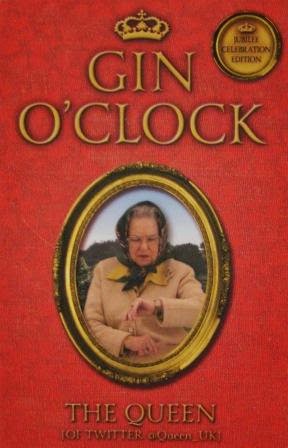
I, like many people, have often looked at the Royal Family during state functions or PR opportunities, as they shake hands with complete strangers and do their best to be interested in what they have to say, and thought to myself "What are they really thinking?".  Finally, in 'Gin O'Clock' by the Queen of Twitter, we might find out.

'Gin O'Clock' by The Queen
(of Twitter) (Hodder, 2012)

Following in the ink blots of her illustrious ancestress Queen Victoria, HM Elizabeth II has decided to publish her memoirs.  But, being a modern queen in modern times, rather than writing them in a leather bound journal, she's made full use of the latest technology, tweeting her thoughts to her adoring subjects.  (At last we know what she keeps in her handbag - a smartphone complete with Twitter ap!).  'Gin O'Clock' is a collection of her messages from December 2011 until June 2012, a time of weddings, visits and - if this is to be believed - an awful lot of wild parties and fried breakfasts.

I bought this book last year because my reading was getting far too serious and I wanted something to cheer me up.  Like more than a million other people, I'd followed @Queen_UK and found the quips funny enough to want to read 'Gin O'Clock'.  After all, I've read several books based on blogs, some of which I've really enjoyed.

Unfortunately, I don't think the humour really translates.  In losing it's immediacy and context in the big news of the day, I think the satire has lost it's edge.  I found myself scrabbling around in my memory trying to recall what was going on at the time, which didn't help really.

Also, after a while some of the jokes also wore a bit thin.  Nick Clegg's colouring in, Prince Edward's campness and Camilla Duchess of Cornwall's interesting fancy dress choices also lost their sparkle after about 100 pages.  That's why it's taken me so long to read it (probably about eight months).  I found the best way to enjoy it was to put it down long enough to have forgotten the running jokes.

I also found the structure rather annoying.  Each part starts with a tweet, which is then covered in more detail.  Trouble is that a few lines in the tweet is often repeated as part of the prose, so something that was funny when first read becomes irritating very quickly.

'Gin O'Clock' does have its very funny moments and unlike some satire it's not really mean or cruel, more cheeky and upbeat.  Unfortunately there weren't quite enough for me.

So I guess we'll just have to keep wondering what is going on in the heads of our Royal Family.  Or at least hope that Her Majesty is as gracious and loving as she says she is and I don't end up writing my next post from the Tower...  It's been nice knowing you!

17 March 2014

Caught between the Devil and the Marshalsea...

Late last year, I knew I'd had a bit more time on my hands than usual, so applied for a couple of prize draws on the Waterstones website.  Last weekend, two books turned up... Whoops.

The first arrival was absorbing historical crime novel 'The Devil in the Marshalsea', Antonia Hodgson's first book.

'The Devil in the Marshalsea'
by Antonia Hodgson
(Hodder & Stoughton, 2014)
Tom Hawkins is in the worst possible trouble.  Unable to resist the lure of London, its coffeehouses, brothels and gambling dens, relying luck and living life to the full, he finds himself not just penniless but in debt and heading towards the feared Marshalsea debtors' prison.  Estranged from his vicar father, not knowing who to trust and reliant on his best friend Charles Buckley, he soon realises he has no hope of raising either the money to pay his debt or fund his stay in the Master's side of the prison.  Just as he thinks all hope is lost and he is destined for death from jail fever in the Common Side, Hawkins is thrown a lifeline.  A murder has taken place at the Marshalsea and Buckley's rich patron promises Hawkins his freedom if he finds the killer.  But to do so, he must negotiate the prison's complex web of truth, lies and alliances.  Can he do it before he becomes the Marshalsea's latest victim?

To begin with, I absolutely loved 'The Devil in the Marshalsea'.  Ms Hodgson has used her research well and did a fantastic job of evoking this time and a place.  Equally, Hawkins is an easy character to become attached to.  He's impulsive and flawed but hard not to like and identify with.  After all, we're all only human.

Although I felt that this was a good read overall, I felt that the ending was disappointing.  I can't go into detail because I don't want to give away the mystery at the heart of the novel, but I felt that both the murderer and motive were a bit cliched and disappointing after such a well crafted set up.  I say cliched because it seems that the murderer has two attributes that keep reappearing in TV crime dramas and seem to say more about modern attitudes than having anything to do with good plotting.  What happened to the good old days when characters killed each other for lust, greed or revenge?

It took me a while to work out what the other thing that bothered me was.  Quite near the end of the book, as Hawkins looses all faith and becomes dehumanised by the brutality he has both seen and suffered, he begins to change quite dramatically.  By the end of the book, however, he seems to have forgotten what he's been through and back to his happy-go-lucky ways, neither looking back nor thinking what he might be able to do to help those left behind, even on the ghastly Common Side of the prison.  I could understand a character just wanting to run away and leave the Marshalsea and its inhabitants behind a mental as well as physical locked door, but I just found it hard to believe someone who is supposed to be "honourable" would not in the very least want to do something to help those still trapped in the notorious prison, even if they couldn't do much.

Overall, I think this book is let down by the ending, which is a real shame, especially as the writer is such a friendly presence on Twitter.  Putting the ending to one side, 'The Devil in the Marshalsea' was well written, absorbing and taught me about a time and place I wouldn't have otherwise visited.  I certainly hope to see more from this writer and hope that there is much better to come.